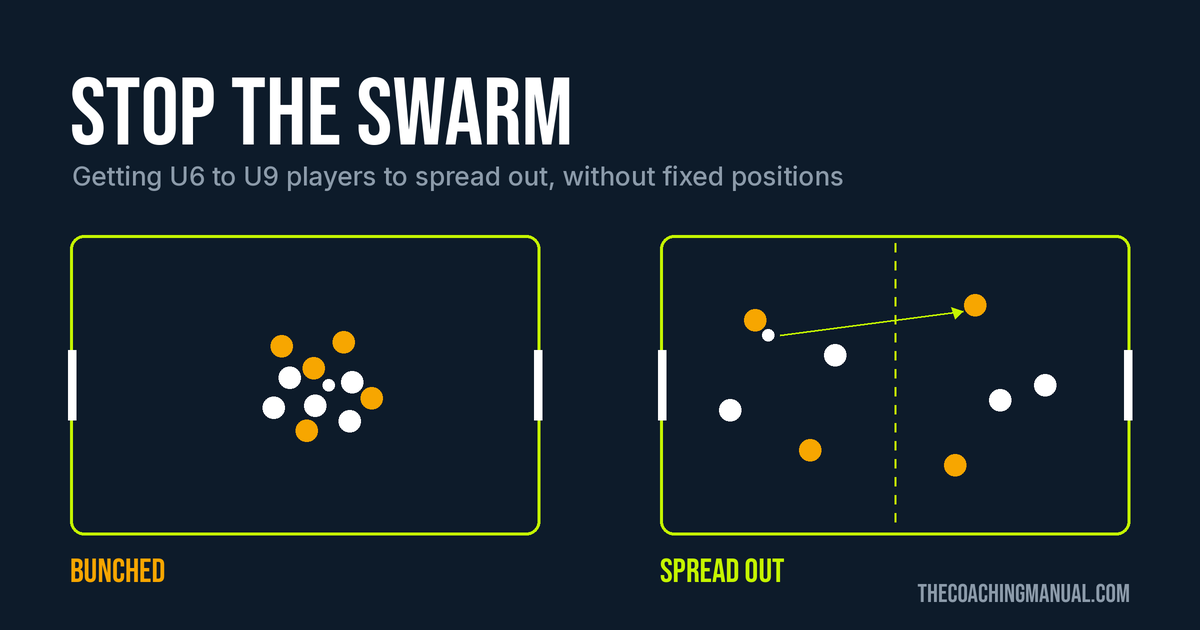
Bunching is normal from U6 to U9, peaking around U7 and U8, so don't try to coach it away with fixed positions. Change the game instead: smaller teams, more balls, wider areas and rules that reward moving away from the ball. Children swarm the ball because it's the most interesting thing on the pitch and they want a touch. Give them a game where moving into space is the quickest way to get one, and they'll spread out on their own.
This guide is for grassroots football (soccer) coaches working with U6 to U9 teams. It covers why the swarm happens, what it looks like at each age, two games from The Coaching Manual library that spread players out without a word about positions, what to say from the touchline, and what to tell parents who want their child told where to stand.
Why young players bunch around the ball
My primary school headmaster used to call it "donkeys after a carrot", and it's hard to improve on. Most five- to eight-year-olds see the game from the ball outwards. They can't yet picture where the space is, or where a team-mate will be in three seconds' time, so they go where the action is. And with one ball between a dozen children, running at it is the obvious way to get a kick.
None of that is a coaching failure. It's what children of this age do. The job isn't to stop them wanting the ball; it's to show them that moving away from it is often the quicker way to get it.
What it looks like by age
U6 and U7: it's all about the ball. Most children won't think about space at all yet, and that's fine. The fix is almost entirely in the set-up: a ball each for much of the session, games of 2v2 or 3v3, and plenty of goals. If everyone is getting lots of touches, the swarm matters far less.
U8 and U9: they start to see space, if the game shows it to them. This is when rules that reward moving away from the ball start to work, and when the two games below earn their place. By U9, with bigger matches on the way, some players will begin to support from in front and behind without being told. Others won't, and that's normal too.
Two games that spread players out
1. Creating space and support play: zones, not positions
This practice from Andy Martino locks players into zones, so they spread out because the rules say so, not because someone has been told "you're the defender".
- Area: 30x20, split into two halves, with a goal at each end
- Players: 2v2 in each half (the original uses nine players)
- Time: 15 minutes
- Rules: players stay in their own half. The team on the ball looks to pass forward to team-mates in the other half, who try to score.
Why it works. A child can't join the swarm if they're not allowed in that half. The players in the far half quickly learn that if they find space, the ball comes to them. That's the lesson you want, learned without a single instruction about where to stand.
What to coach: the quality of the pass, making an angle so a team-mate can see you, and supporting the player on the ball.
Make it easier: start with the ball in hands, or make the area bigger. This suits younger or less confident groups.
Make it harder: make the area smaller or limit touches. Or let a player who receives play the ball back into the other half, so a support player there can turn and finish in the opposite goal. This suits U9s who are starting to understand support.
See the full practice, with animation
2. Handball warm-up: you only get the ball by moving
This warm-up from Andy Marks uses hands, which takes the footwork out of the way so children can concentrate on movement.
- Area: 20x15, with a goal
- Players: up to 10
- Time: 10 minutes
- Rules: players can go anywhere, but can only take two steps while holding the ball. To score, a team-mate has to serve it to you; you can't serve to yourself.
Why it works. If you can't run with the ball, the only way your team keeps it is by someone getting free for a throw. And because you can't score from your own serve, finishing depends on a team-mate finding space too. Children work out quickly that standing next to the ball gets them nothing.
One change for this age group. The original finishes with headers and volleys. Leave the heading out: England's FA guidance and US Soccer's rules both rule out deliberate heading for players this young. Finish with a volley from a team-mate's throw, or a throw into the goal.
What to coach: movement off the ball, support, and different ways to finish.
See the full practice, with animation
In every session
- More balls. One each in the warm-up, one between two where you can.
- Smaller teams. Two games of 3v3 teach more than one game of 6v6, because everyone is close to the ball more often.
- Wider areas. Wider than you think. Width gives children somewhere to go.
- More than one goal. Two small goals at each end give players a reason to look up and switch play.
What to say from the touchline
- "Where's the space?"
- "Can you help your friend?"
- "Help in front, or help behind?"
- Praise the child who moved away and got the ball, out loud, so the others hear it.
What not to shout: "Spread out!" Children hear the words but don't know where to go, so they take three steps away and run straight back. Questions make them look up; instructions make them look at you.
Common mistakes
Fixed positions too early. It gives you a tidy picture and a bored child standing on a wing who touches the ball twice a game.
Big-sided games in training. Matches at this age are small-sided, but a 6v6 training game with one ball still means most children are spectators.
Stopping the game to move players. Let the rules and the area do the work, and keep them playing.
Expecting it to disappear in a week. Bunching fades over a season or two, as children start to see more of the game. That's development, not a problem you've failed to fix.
What to tell parents who want fixed positions
In life we always indulge children in their ambitions for what they want to be when they grow up, and we rightly encourage them. But as parents we also know it's important for them to develop other interests and explore other opportunities as they grow. To do otherwise would be negligent.
It should be the same in sport. It's important to encourage players to play the roles they enjoy, but we have a responsibility to give them the chance to try other roles as well. So at this age, every child attacks, defends and has a go in goal. There's plenty of time for positions later, and they'll choose better once they've tried them all.
Next step
Both games are in The Coaching Manual's library with full set-ups and animations. For more sessions organised by age group, browse the free coaching sessions library. If you're responsible for coaching across a club, see how The Coaching Manual supports clubs.
FAQ
Is it bad that my U8 team bunches around the ball?
No. It's normal for the age, and it's often at its worst around U7 and U8. Children see the ball before they see the space around it. Smaller teams, more balls and zone games will help them spread out naturally over a season.
When does bunching stop?
Gradually, usually by around U9 or U10, as children start to read more of the game and matches get bigger. It rarely stops all at once, and some players will get there a season before others.
When should young players start learning positions?
Gradually, as match formats get bigger, usually around U9 and U10 when teams move to 7v7. Even then, keep rotating players so they learn the game from more than one place on the pitch.
Should I use cones to show players where to stand?
Use cones to mark zones, as in the first game above, rather than individual spots. Zones still let children make their own decisions about where the space is. A cone for each child just teaches them to stand still.