Home / Age groups / U9

Under 9s · football (soccer) drills

U9 football drills: a session built on 1v1s

Coaching under 9s tonight? Run the session below. It starts with a game as players arrive, works on beating a defender 1v1, and finishes with a small-sided game where they try it for real. Every drill has a diagram and coaching points.

  • 60minute sessions
  • 5v5England matches
  • 7v7US matches

U9 at a glance

  • England match format5v5. U9s stay at 5v5 for an extra year from 2026/27.
  • US match format7v7.
  • Session length60 min
  • Coaching focusSkills come quickly now. Keep sessions game-based and full of 1v1s.
What to expect

What under 9s need

The FA’s four corners, with technical and tactical split, because at this age they need very different amounts of attention.

Technical

Often called the golden age for learning skills. Receiving on the half turn, passing over different distances, 1v1 attacking and defending, finishing.

Tactical

Small-unit ideas: support angles, width, creating space, pressure and cover. Try different positions rather than fixing them.

Physical

Coordination is easy to build now. Speed and agility through games. Some children start growing early.

Psychological

More self-aware and more likely to compare themselves with others. They can handle more detail and good questions.

Social

Team identity grows and peer opinion matters. Give responsibility: setting up, leading a warm-up, captain for the night.

How coaching changes from U5 to U18 →

Session plan · about 60 minutes

Training in an hour? Run this

A complete under 9s session using Play, Practice, Play, from our U9–U10 season plan. You need cones, bibs and balls. Open the full session in TCM or read how Play, Practice, Play works.

Play: gamesPractice: one theme, lots of repetitionTake a quick drinks break between each block.

7 drills with diagrams

U9 drills

Every drill comes from our U9–U10 season plan on The Coaching Manual, where you’ll find the full session with an animation. Areas are in metres or yards: near enough is fine.

Diagram: 3v3 arrival game
Diagram from The Coaching Manual · By Steven Crane
Drill 1 · In the session plan

3v3 arrival game

Players start playing the moment they arrive, so nobody stands around waiting for a late start.

  • 15 min
  • Area 25 x 15 (two pitches)
  • Up to 12 players
  • 6 bibs, 10 cones, 2 balls

How it works

  1. Mark out small pitches, roughly 15 x 10 each.
  2. Lay two colours of bibs on each pitch. As each player arrives they grab a bib and join in.
  3. It starts as 1v1, then becomes 2v1, 2v2 and 3v3 as more players turn up.

Coaching points

  • Just play. No coaching yet. Let them get touches and enjoy it while you greet parents and finish setting up.

Open the full session with animation in TCM

Diagram: Attacking 1v1
Diagram from The Coaching Manual · By James Baxter
Drill 2 · In the session plan

Attacking 1v1

Non-stop 1v1s. Players work hard, rest while the other team goes, and get plenty of goes at beating a defender.

  • 15 min
  • Area 20 x 20
  • 8 players
  • 4 balls, 4 bibs, 12 cones

How it works

  1. Two teams, each attacking their own goal on the diagonal. Goals only count from inside the end zone.
  2. Play 1v1. The attacker tries to score; the defender tries to win the ball and dribble it into the target square.
  3. When the go finishes, the attacker becomes the defender and the next attacker from the other team goes.

Coaching points

  • Change speed and direction. Slow down to set the defender up, then go.
  • Use a skill. Pick a move to get past the defender.
  • Accelerate into space. Once you’re past, attack the space quickly.
Make it easier or harder

Make it easier

  • Play 2v1 so attackers have more chance of success.

Make it harder

  • Score in any goal: the goal in front is worth 1, the diagonal goal 2, and the defender’s target square 5.
  • Play 2 defenders against 1 attacker.

Open the full session with animation in TCM

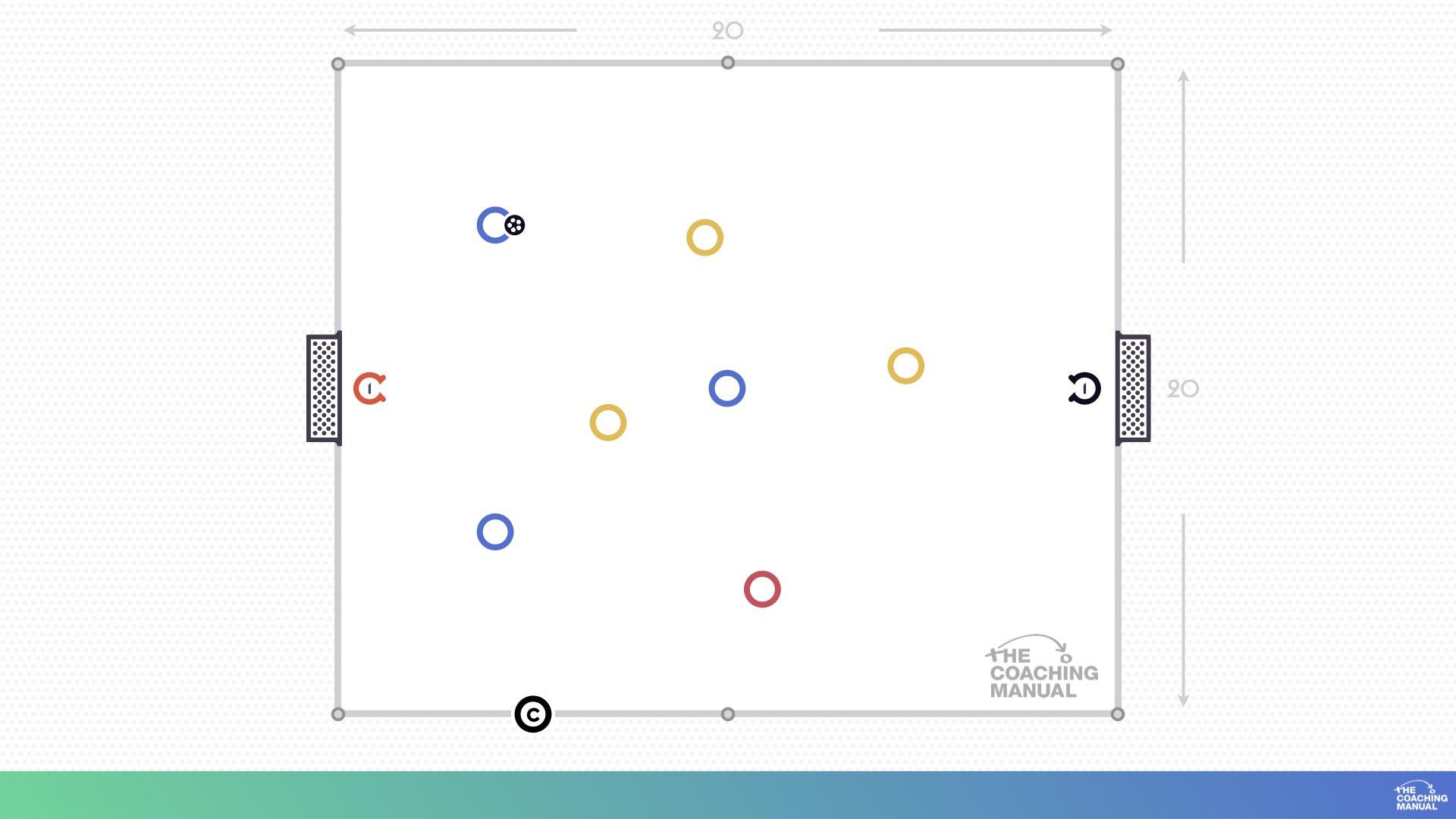
Diagram: Small-sided game
Diagram from The Coaching Manual · By James Baxter
Drill 3 · In the session plan

Small-sided game

The reward at the end of the session, and the chance to take players on for real.

  • 25 min
  • Area 20 x 20
  • 10 players
  • 4 balls, 10 bibs, 12 cones

How it works

  1. Set up even teams. With odd numbers, give one team an extra player and swap it round if the game gets one-sided.
  2. Praise players who are brave in 1v1s, whether or not they win them.

Coaching points

  • Look up and decide. Dribble, run with it or pass?
  • Receive to turn. Open up so you can face forward.
  • Take players on. Use what you practised in the 1v1s.

Open the full session with animation in TCM

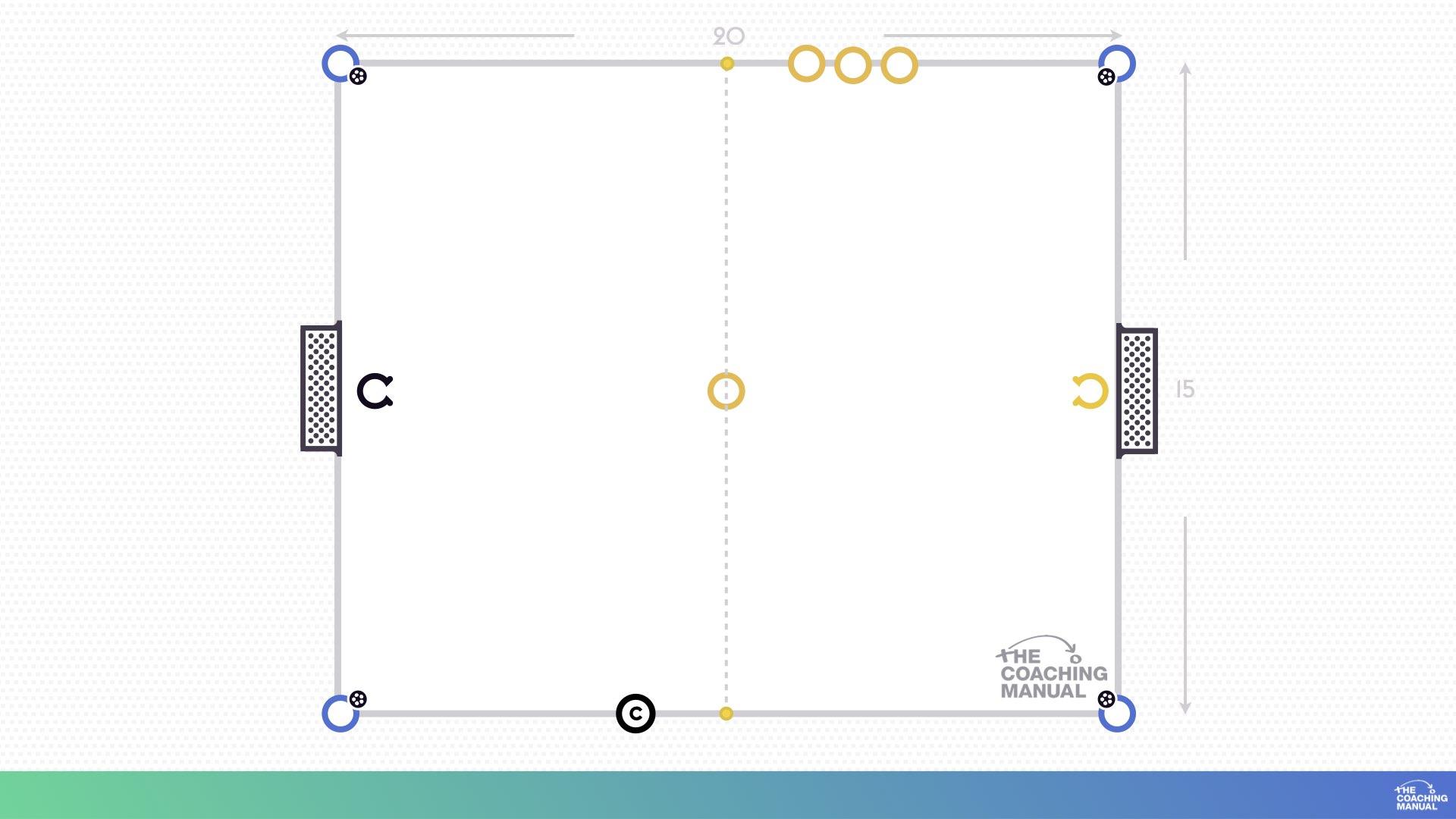
Diagram: Dribble or run with it
Diagram from The Coaching Manual · By James Baxter
Drill 4

Dribble or run with it?

One defender, two attackers. The one who gets pressed has to dribble; the one left alone should run with the ball and finish.

  • 15 min
  • Area 20 x 15
  • 10 players
  • 4 balls, 10 bibs, 12 cones, 2 goals with goalkeepers

How it works

  1. Mark a halfway line with a goal and goalkeeper at each end.
  2. Two attackers set off at the same time towards opposite goals. One defender in the middle chooses which one to press.
  3. The pressed attacker dribbles to get a shot away. The other runs with the ball and finishes unopposed. Rotate players and teams.

Coaching points

  • Look up. Know whether the defender is coming for you.
  • First touch. Push it into space if you’re free, keep it close if you’re not.
  • Finish. Get the shot away early.
Make it harder

Make it harder

  • If the defender wins the ball, they can attack a goal too.

Open the full session with animation in TCM

Diagram: Defending 1v1
Diagram from The Coaching Manual · By Gary McDermott
Drill 5

Defending 1v1

The other half of the 1v1: closing down quickly, getting the body shape right and forcing the attacker one way.

  • 15 min
  • Area 20 x 20
  • 4 players per area
  • 2 balls, 4 bibs, 16 cones

How it works

  1. Set up gates along each end line.
  2. The defender passes to the attacker, who tries to dribble through any gate on the defender’s line.
  3. If the defender wins the ball, they score by dribbling through a gate on the attacker’s line. Swap roles after five goes.

Coaching points

  • Close down quickly. Get to the attacker while the ball is travelling.
  • Body shape. Side-on and low, ready to move either way.
  • Force them one way. Show the attacker where you want them to go.
Make it easier or harder

Make it easier

  • Give attackers only one gate to attack, so the play is more predictable.

Make it harder

  • The attacker starts with the ball and runs at the defender at speed.

Open the full session with animation in TCM

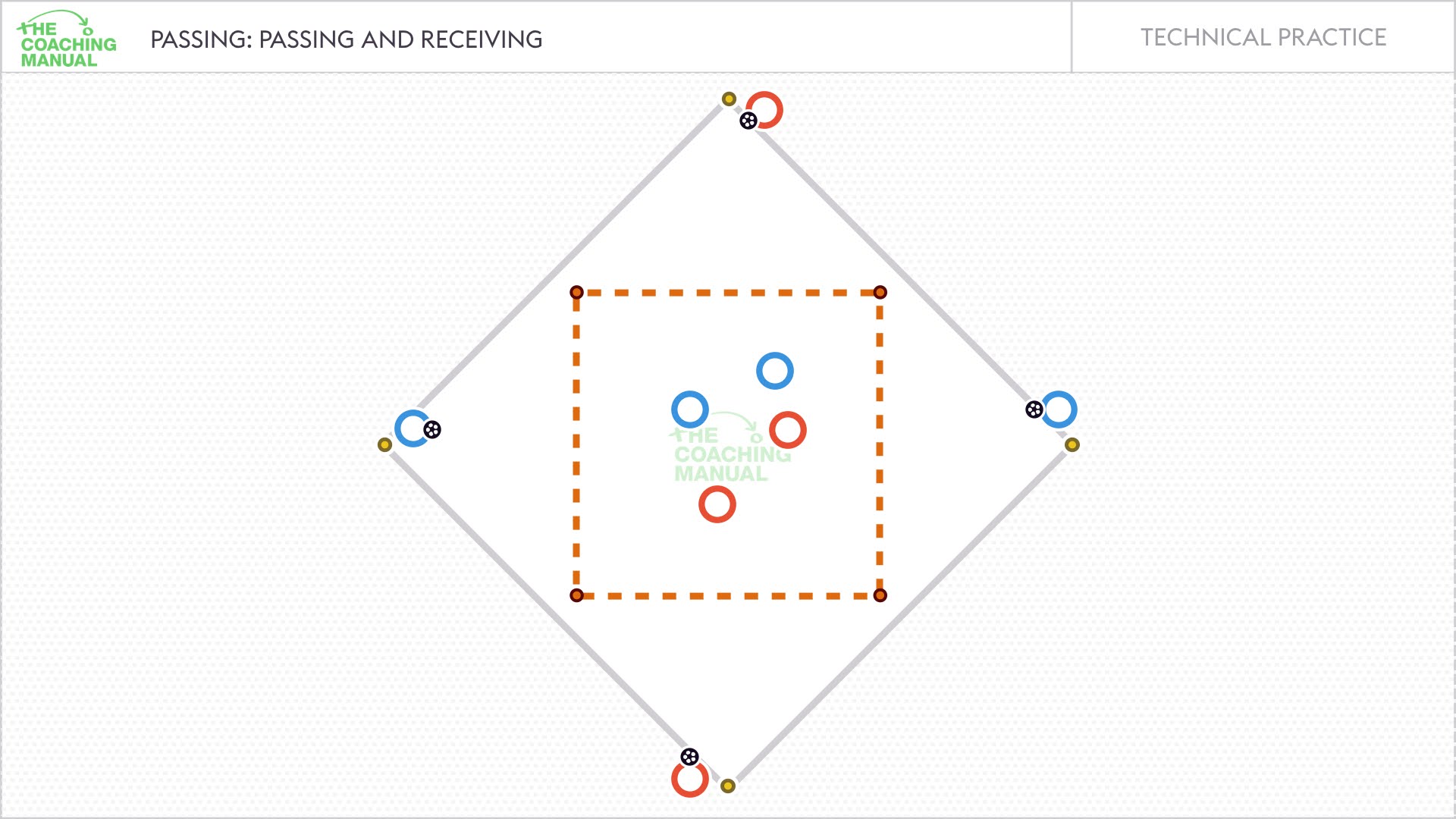
Diagram: Passing and receiving through the middle
Diagram from The Coaching Manual · By James Baxter
Drill 6

Passing and receiving through the middle

Realistic passing and receiving in a busy area, so players have to look around and communicate.

  • 15 min
  • Area 20 x 20
  • 8 players
  • 2 balls, 8 bibs, 12 cones

How it works

  1. Two teams. Teammates stand on opposite cones, with two players from each team in the middle.
  2. A middle player receives from a teammate on a cone, dribbles through the area and passes to the teammate on the opposite cone.
  3. They get it back and go again.

Coaching points

  • Look around. Know where the space and other players are before the ball arrives.
  • Quality pass. Weight and accuracy so your teammate can play first time.
  • Be positive. Receive and go forward when you can.
Make it harder

Make it harder

  • Add a defender in the middle.

Open the full session with animation in TCM

Diagram: Creating space to support
Diagram from The Coaching Manual · By Andy Martino
Drill 7

Creating space to support

A 6v3 keep-ball that teaches players where to stand so the player on the ball always has a pass.

  • 15 min
  • Area 25 x 25 (one half and two quarters)
  • 9 players
  • 4 balls, 9 bibs, 14 cones

How it works

  1. Split the area into one half and two quarters. Play 6v3.
  2. The six make three passes, then break out into one of the smaller areas to make three more, then move again.
  3. If the three win the ball, they make two passes and move to another area. If the ball goes dead, restart in the big area with the six.

Coaching points

  • Look around. Know where the defenders and the space are.
  • Support angles. Get to where the passer can see you, not behind a defender.
  • Body shape. Open up so you can play the next pass.
  • Quality pass. Firm and to the right foot.
Make it easier or harder

Make it easier

  • Start with the ball in the hands.

Make it harder

  • Make the areas smaller.

Open the full session with animation in TCM

Common question

What should U9s be working on?

Eight and nine-year-olds learn skills faster than at almost any other age, so this is when to invest in technique. In England they also stay at 5v5 for another season, which means lots of touches and lots of 1v1s on matchday too.

  1. 1v1s, every session. Beating a defender and stopping an attacker are the foundations of everything that comes later.
  2. Dribble or run with it? Teach them to keep it close when it’s busy and push it into space when it’s open.
  3. Receive on the half turn. Side-on, so they can see the pitch and play forward.
  4. Support angles. Simple ideas about where to stand so a teammate always has a pass.
  5. Ask, don’t tell. “Where was the space?” gets better learning than telling them where it was.
  6. Rotate positions. Every player tries every position, goalkeeper included.

Questions coaches ask

What should I do with my under 9s at training?

Start with a 3v3 game as players arrive, then a 1v1 attacking practice, and finish with a small-sided game. That's the session on this page.

What format do U9s play?

In England, 5v5 from the 2026/27 season. US Soccer recommends 7v7.

How long should an under 9s training session be?

About an hour, with drinks breaks and most of the time spent in games and game-like practices.

What should U9s be working on?

1v1 attacking and defending, dribbling and running with the ball, receiving on the half turn, passing and finishing. Tactically, simple ideas like support angles and finding space.

Other ages

Drills for every age

Pick an age to see its drills and session plan, or read what to expect at each age.

A season plan for every age

The Coaching Manual has 2,000+ full sessions with video, and ready-made season plans for every age group. Start free as a coach, or give every coach at your club the same plan.