Home / Age groups / U6

Under 6s · football (soccer) drills

U6 football drills: fun games for 6-year-olds

Six-year-olds learn football by playing it. The best U6 sessions give every child a ball or a game straight away, keep teams tiny (1v1 to 3v3) and avoid queues, laps and long talks. Here's a 45-minute session plan and six games that keep everyone involved.

  • 45minute sessions
  • 1v1-3v3games in training
  • 4v4US matches

U6 at a glance

  • England match formatNo affiliated matches until U7, so play 1v1 to 3v3 games in training.
  • US match format4v4 with no goalkeepers.
  • Session length45 min
  • Coaching focusStill play first, but children can now follow simple rules and enjoy keeping score.
What to expect

What under 6s need

The FA’s four corners, with technical and tactical split, because at this age they need very different amounts of attention.

Technical

Lots of touches. Dribbling, stopping the ball, turning and shooting, with both feet. A ball each wherever possible.

Tactical

Almost none. Which way am I going, where is the goal, where is some space. That is plenty.

Physical

Running, jumping, hopping, landing, changing direction. Agility, balance and coordination through games, never laps.

Psychological

Short attention spans, so short explanations. Confidence comes from success, so make sure every child scores and wins sometimes.

Social

Most play next to each other rather than with each other. Sharing the ball is hard. Taking turns is a skill to learn.

How coaching changes from U5 to U18 →

Session plan · 45 minutes

A 45-minute U6 session

Built on Play, Practice, Play: start with a game, practise one thing, finish with a game. How Play, Practice, Play works.

Play: gamesPractice: one theme, lots of repetition

6 drills with diagrams

U6 drills

Every drill comes from The Coaching Manual, where you’ll find the full version with an animation. Areas are in metres or yards: near enough is fine.

Diagram: 3v3 arrival game
Diagram from The Coaching Manual · By Steven Crane
Drill 1 · In the session plan

3v3 arrival game

Gets children playing the moment they arrive, so nobody stands around waiting for a late start.

  • 10 min
  • Area 25 x 15 (two pitches)
  • Up to 12 players
  • 6 bibs, 10 cones, 2 balls

How it works

  1. Mark out small pitches, roughly 15 x 10 each.
  2. Lay two colours of bibs on each pitch. As each child arrives they grab a bib and join in.
  3. It starts as 1v1, then becomes 2v1, 2v2 and 3v3 as more players turn up.

Coaching points

  • Just play. No coaching yet. Let them get touches and enjoy it while you greet parents and finish setting up.

Open the full drill with animation in TCMFree to view

Diagram: Ball mastery and dribbling numbers game
Diagram from The Coaching Manual · By Lee Fletcher
Drill 2 · In the session plan

Ball mastery and dribbling numbers game

Dribbling and beating a defender in short, exciting bursts, with everyone listening for their number.

  • 15 min
  • Area 30 x 20
  • 8 players
  • Mini-goals, 8 bibs, a ball for the coach to feed

How it works

  1. Give every player a number. Players wait beside the mini-goals at each end.
  2. Shout a number. Those players run on and play 1v1, with you rolling the ball in.
  3. Shout more numbers during play to make it 2v2, 3v3 or 4v4. Keep score.

Coaching points

  • Listen and look. Players need to know their number, be ready and spot where their opponent is as they come on.
  • Beat the player. Use a move to get past the defender, not just a big kick forward.
  • Close control. Little touches so the ball is always near enough to change direction.
  • Pass when it is on. If there is no space to dribble, pass. But praise brave dribbling first.
Make it easier or harder

Make it harder

  • Give out super powers: three goals for dribbling past a defender and scoring, or for scoring after a pass.

Open the full drill with animation in TCMFree coach account

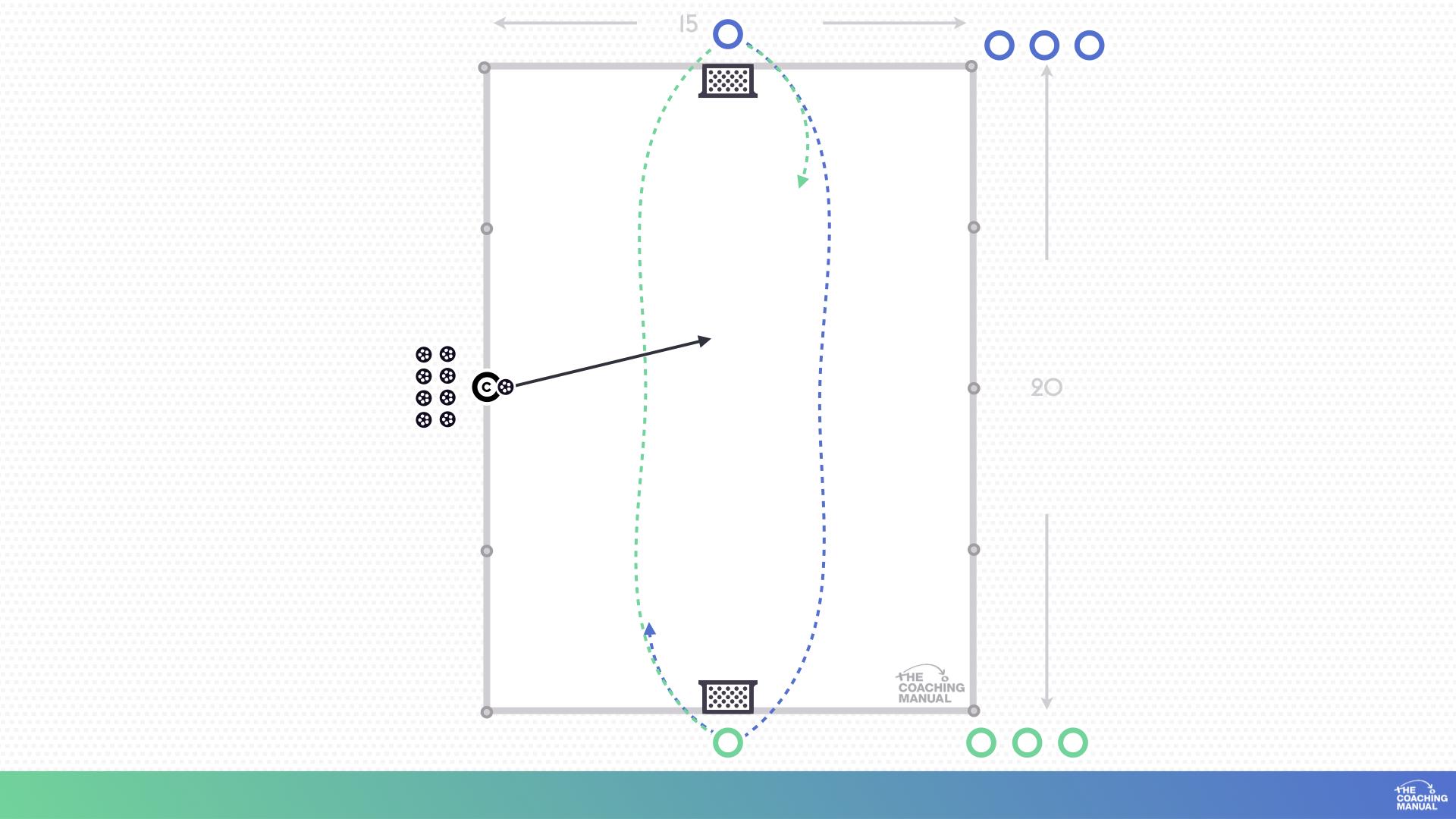
Diagram: 1v1 race
Diagram from The Coaching Manual · By Lee Fletcher
Drill 3 · In the session plan

1v1 race

A race and a 1v1 in one. Children love it, and it builds speed, close control and the courage to take a defender on.

  • 15 min
  • Area 20 x 15
  • 8 players
  • 2 mini-goals, 8 bibs, 10 balls

How it works

  1. One player from each team stands behind each goal.
  2. On your call they race around the opposite goal and into the area.
  3. Roll the ball to whoever gets round first. They attack the goal they started behind; the other player defends.
  4. When the ball goes out or a goal goes in, the next pair go.

Coaching points

  • Head up. See where the defender is as the ball arrives.
  • Beat the player. Use a move to get past rather than running into the defender.
  • Close control. Keep the ball close so the defender can't nick it.
Make it easier or harder

Make it harder

  • Send two players from each side at once.
  • Let players score in either goal, so they have to turn.

Open the full drill with animation in TCMFree coach account

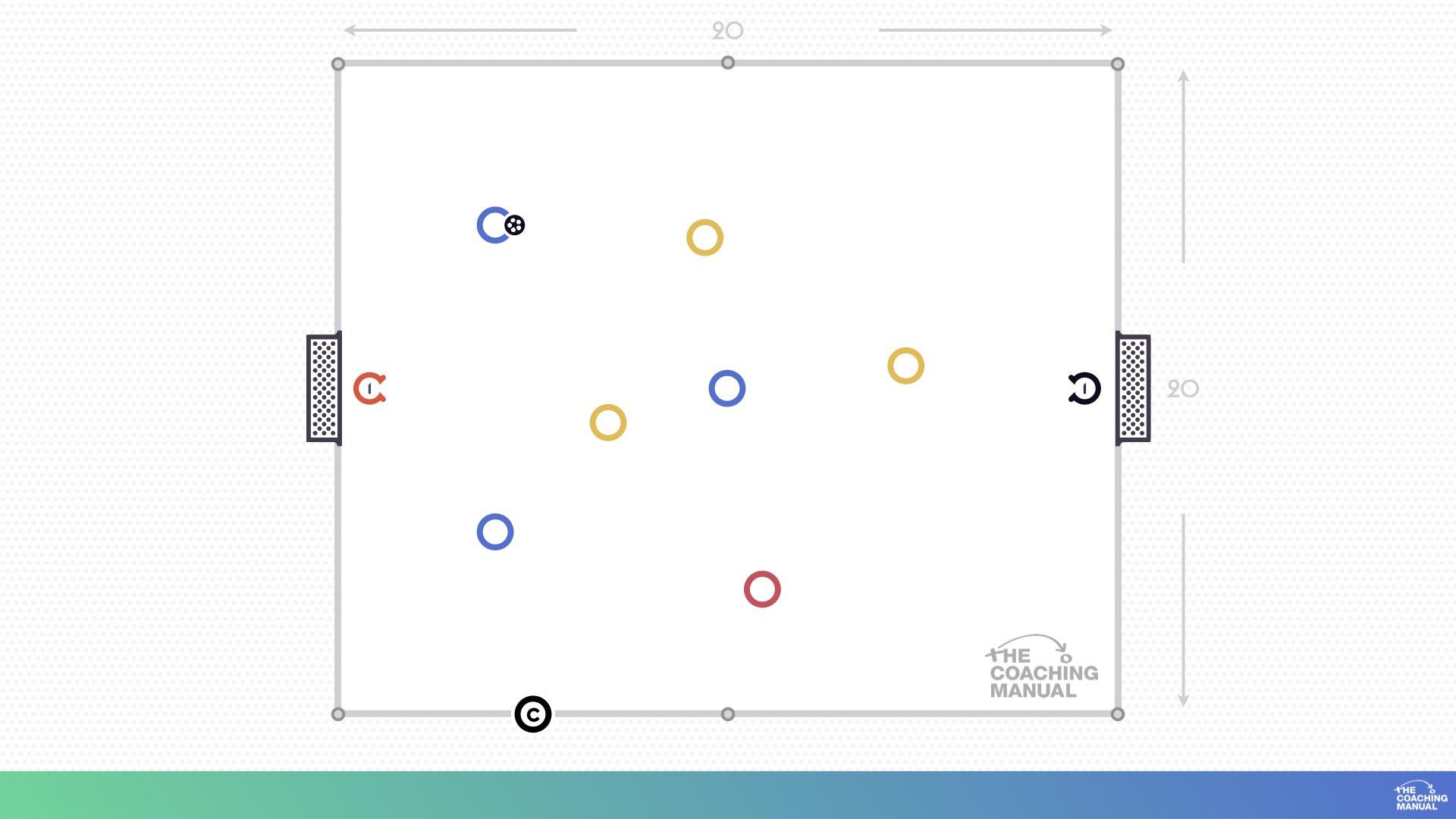
Diagram: 1v1 four-goal game
Diagram from The Coaching Manual · By Louie Cordwell
Drill 4

1v1 four-goal game

A small game where four goals mean there is always space to attack, so children get lots of 1v1s.

  • 15 min
  • Area 20 x 20
  • 8 to 12 players (three teams of four)
  • 4 mini-goals, bibs, 1 ball

How it works

  1. Two teams play with a goal in each corner, so each team can score in two goals.
  2. The third team waits. Every four minutes the winners stay on.
  3. Give each team a 'manager' who sets the team a challenge, and rotate the manager every game.

Coaching points

  • Look up. See the space, the defender and your teammates before deciding what to do.
  • Win your 1v1. Use moves and turns with both feet.
  • Pass if you can't dribble. Pass with the right weight to a teammate in space.
Make it easier or harder

Make it easier

  • Make the area bigger.
  • Use fewer defenders.

Make it harder

  • Set individual challenges.
  • Add defenders.

Open the full drill with animation in TCMPremium

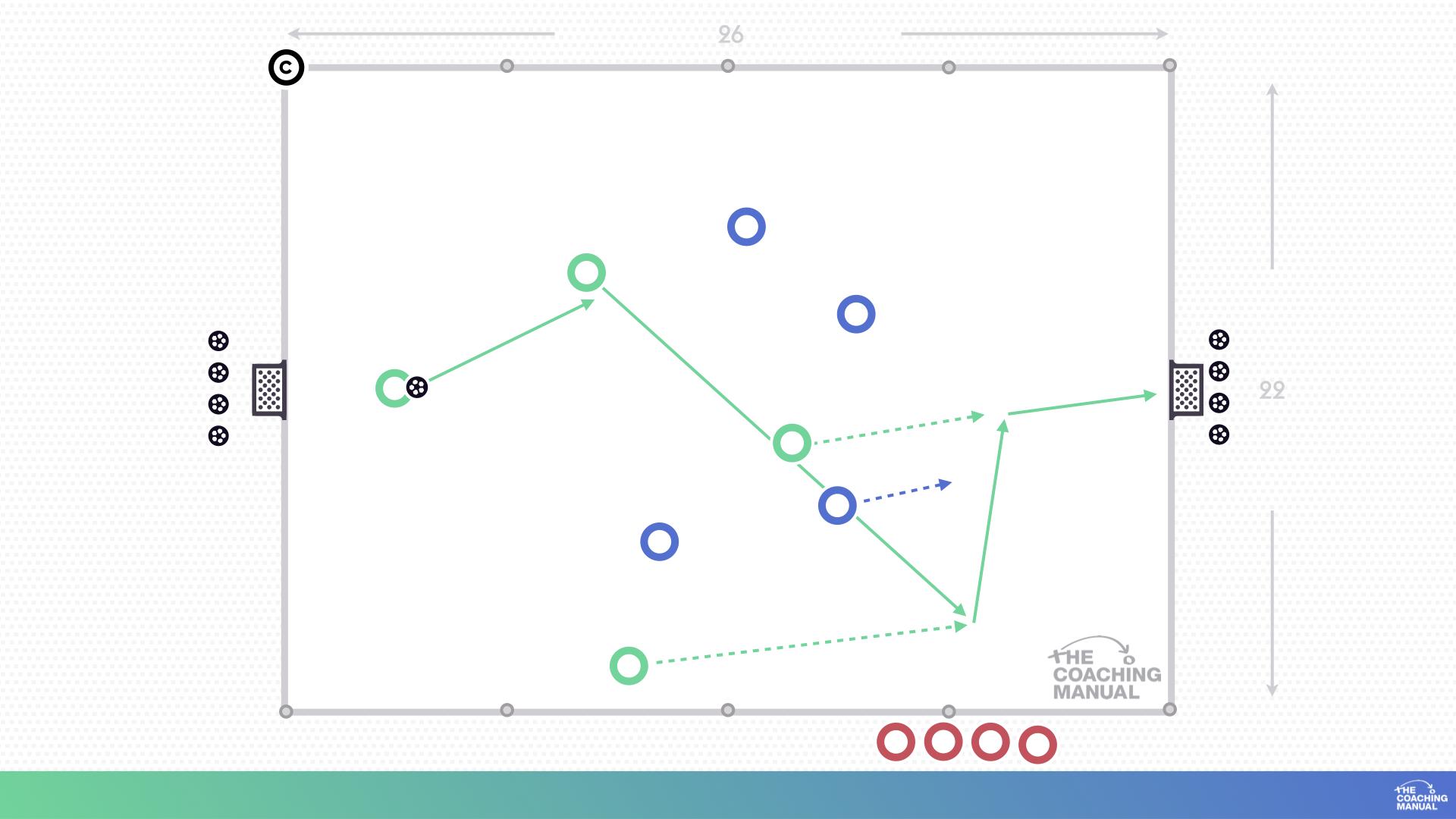
Diagram: Winner stays on
Diagram from The Coaching Manual · By Lee Fletcher
Drill 5 · In the session plan

Winner stays on

Short 4v4 games with a reason to try hard. The perfect way to finish a session.

  • 20 min
  • Area 26 x 22
  • 12 players (three teams of four)
  • Goals, bibs, spare balls

How it works

  1. Play 4v4 games of four minutes. The winners stay on and the next team comes on.
  2. A draw goes to the team that scored last. At 0-0, settle it with rock, paper, scissors.
  3. Whoever is still on after 20 minutes is the overall winner.

Coaching points

  • Let them play. Your job is to encourage. Let the children express themselves.

Open the full drill with animation in TCMPremium

Diagram: End-of-session small-sided game
Diagram from The Coaching Manual · By James Baxter
Drill 6

End-of-session small-sided game

A proper game to finish, where children use what they practised.

  • 25 min
  • Area 20 x 20
  • Up to 10 players
  • Goals, bibs, 4 balls

How it works

  1. Pick even teams, or give one team an extra player and swap if it gets one-sided.
  2. Play normal rules. Keep spare balls by the goals so the game restarts quickly.

Coaching points

  • Heads up. Look up while dribbling to see the ball, the space, teammates and opponents.
  • Receive. Use different parts of the foot to control the ball and move forward.
  • Turn. Use moves to turn and face forward.
  • Dribble or run. Dribble to escape tight spots. If there's space, run with the ball into it.

Open the full drill with animation in TCMFree to view
Common question

How to keep every 6-year-old involved

The question we hear most from U6 coaches is how to stop half the group standing around. These rules fix most of it.

  1. No queues longer than two. If more than two children are waiting, split the group or set up a second area.
  2. A ball each to start. Warm-ups with a ball each mean hundreds of touches before any game starts.
  3. Tiny teams. 1v1, 2v2 and 3v3. In a 6v6, most children never touch the ball.
  4. Short games, quick rotations. Three or four minutes, then change opponents or swap teams.
  5. Challenges, not instructions. “Can you score with your other foot?” works better than a two-minute talk.
  6. No laps, no lines, no lectures. Six-year-olds get fit and learn by playing.

Questions coaches ask

How long should a U6 football session be?

About 45 minutes. Six-year-olds lose focus in longer sessions, so keep it short, busy and finish with a game.

How many players per side should U6s play?

In training, 1v1 to 3v3 so every child touches the ball constantly. In England affiliated matches start at U7 with 3v3. US Soccer recommends 4v4 with no goalkeepers.

Should 6-year-olds play positions?

No. Let them chase, dribble and score. Bunching around the ball is normal at this age and positions mean nothing to them yet.

Do U6s need goalkeepers?

No. Use small goals with no keepers so there are more goals, more success and nobody stuck in goal.

Other ages

Drills for every age

Pick an age to see its drills and session plan, or read what to expect at each age.

A season plan for every age

The Coaching Manual has 2,000+ full sessions with video, and ready-made season plans for every age group. Start free as a coach, or give every coach at your club the same plan.