Home / Age groups / U8

Under 8s · football (soccer) drills

U8 football drills: a session for under 8s

Got training in an hour with your under 8s? Run the 60-minute session below. It starts with a game as players arrive, works on dribbling, passing and finding space, and finishes with a six-goal game that stops everyone chasing the same ball. Every drill has a diagram and coaching points.

  • 60minute sessions
  • 5v5England matches
  • 4v4US matches

U8 at a glance

  • England match format5v5 (U7s now play 3v3 from 2026/27).
  • US match format4v4 with no goalkeepers.
  • Session length60 min
  • Coaching focusDribbling confidence first, passing second. Expect bunching and design games that spread play out.
What to expect

What under 8s need

The FA’s four corners, with technical and tactical split, because at this age they need very different amounts of attention.

Technical

Close control, beat-the-player moves and turns. First passes and receiving. Shooting with both feet.

Tactical

When to dribble and when to pass. Starting to notice teammates. Bunching around the ball is normal: fix it with the game, not by shouting positions.

Physical

Coordination, agility and quick changes of direction. Short, intense games with plenty of rest.

Psychological

They care about winning and can be upset by losing. Challenges, points and personal bests work well.

Social

Friendships form. Pairs and small groups work. Fair rotation and equal playing time matter to them.

How coaching changes from U5 to U18 →

Session plan · 60 minutes

Training in an hour? Run this

A complete 60-minute under 8s session using Play, Practice, Play. You need cones, bibs, a ball each and six mini-goals. How Play, Practice, Play works.

Play: gamesPractice: one theme, lots of repetitionTake a quick drinks break between each block.

7 drills with diagrams

U8 drills

Every drill comes from The Coaching Manual, where you’ll find the full version with an animation. Areas are in metres or yards: near enough is fine.

Diagram: 3v3 arrival game
Diagram from The Coaching Manual · By Steven Crane
Drill 1 · In the session plan

3v3 arrival game

Gets children playing the moment they arrive, so nobody stands around waiting for a late start.

  • 10 min
  • Area 25 x 15 (two pitches)
  • Up to 12 players
  • 6 bibs, 10 cones, 2 balls

How it works

  1. Mark out small pitches, roughly 15 x 10 each.
  2. Lay two colours of bibs on each pitch. As each child arrives they grab a bib and join in.
  3. It starts as 1v1, then becomes 2v1, 2v2 and 3v3 as more players turn up.

Coaching points

  • Just play. No coaching yet. Let them get touches and enjoy it while you greet parents and finish setting up.

Open the full drill with animation in TCMFree to view

Diagram: Ball mastery to find space
Diagram from The Coaching Manual · By Andy Martino
Drill 2 · In the session plan

Ball mastery to find space

Every player gets hundreds of touches and learns to look up and find space, which is the start of fixing bunching.

  • 10 min
  • Area 10 x 10 (bigger for more players)
  • 8 players
  • A ball each, 12 cones

How it works

  1. Every player has a ball inside the area.
  2. Players dribble and try tricks, keeping away from each other and finding empty space.
  3. Call out a trick or a turn every 20 to 30 seconds.

Coaching points

  • Lots of touches. Small, quick touches with both feet and different parts of the foot.
  • Heads up. Look up between touches to spot space and other players.
  • Find space. If a space fills up, move to a new one.

Open the full drill with animation in TCMFree to view

Diagram: Passing and receiving circle
Diagram from The Coaching Manual · By Lee Smith
Drill 3 · In the session plan

Passing and receiving circle

Passing, receiving and looking around before the ball arrives, in a busy area that feels like a game.

  • 15 min
  • Area 20 x 20, using the centre circle
  • 12 players (groups of three)
  • 4 balls, bibs

How it works

  1. Work in groups of three, two outside the circle and one inside.
  2. An outside player passes to the inside player, who passes out to the opposite teammate.
  3. Rotate roles every couple of minutes.

Coaching points

  • Three checks. Look around before moving to receive, as you move, and as the ball leaves your teammate's foot.
  • Open body. Stand side-on so you receive on your back foot and can play forward.
  • Move to get free. Inside players move to find space before asking for the ball.
  • Quality pass. Weight, accuracy and timing.
Make it easier or harder

Make it easier

  • Inside players call out when to rotate.

Make it harder

  • Limit to two or three touches.

Open the full drill with animation in TCMFree to view
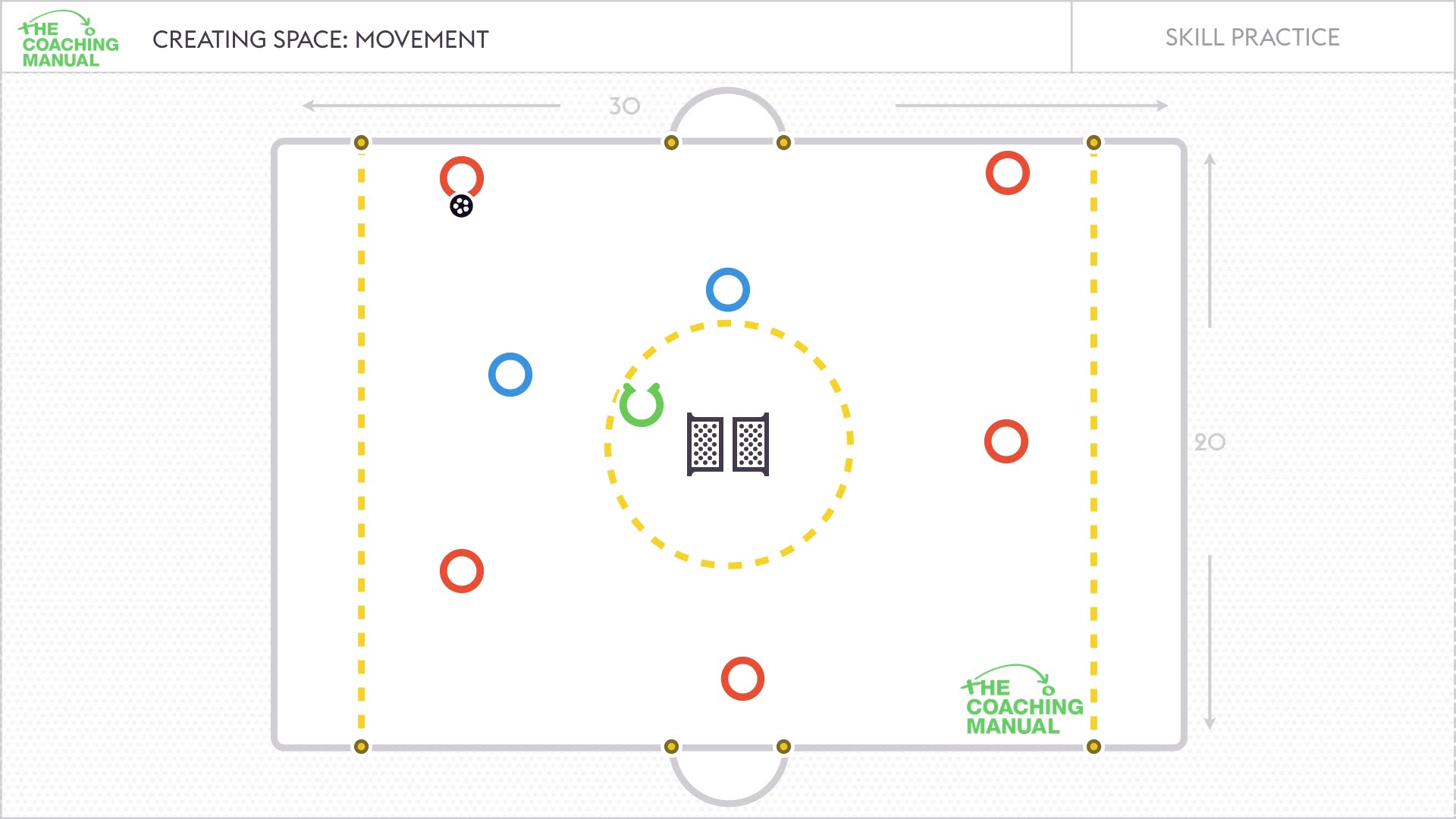
Diagram: Creating space 5v2
Diagram from The Coaching Manual · By Andy Martino
Drill 4

Creating space 5v2

Teaches players to spread out so the team can keep the ball, with an overload that lets them succeed.

  • 15 min
  • Area 30 x 20
  • 8 players
  • 2 goals back to back, a goalkeeper, bibs

How it works

  1. Put two goals back to back in the middle with a goalkeeper defending both.
  2. Play 5v2. The five must make three passes before they can score in either goal. The two need one pass.
  3. First to five goals wins. Rotate players.

Coaching points

  • Width and depth. Spread out: wide, ahead and behind the ball, so there is always a pass on.
  • Heads up. Look around to know where the space is.
  • Make space. Move away from the ball to make room for a teammate.

Open the full drill with animation in TCMPremium

Diagram: Creating space game
Diagram from The Coaching Manual · By Andy Martino
Drill 5

Creating space game

A 3v3 game with a floating player, where the goals reward spreading out.

  • 20 min
  • Area 30 x 20
  • 8 players
  • 1 goal with a goalkeeper, 2 small goals, bibs

How it works

  1. Put a goal and goalkeeper at one end and two small goals at the other.
  2. Play 3v3 plus a floating player who joins whichever team has the ball.
  3. Swap ends so each team practises attacking through the middle and down the sides.

Coaching points

  • Width and depth. Spread out to stretch the defenders.
  • Heads up. Know where teammates and space are before you get the ball.
  • Make space. Move into space, or out of it so a teammate can use it.

Open the full drill with animation in TCMPremium

Diagram: 1v1 dribbling boxes
Diagram from The Coaching Manual · By Lee Fletcher
Drill 6

1v1 dribbling boxes

Lots of 1v1s against defenders who can't leave their box, so players practise protecting the ball and beating a player.

  • 15 min
  • Area 34 x 24
  • Up to 20 players
  • 20 cones, bibs, 10 balls

How it works

  1. Set out squares in a line with an end zone at each end.
  2. Attackers dribble from one end zone to the other, past defenders who must stay in their own box.
  3. A point for each successful run. The next attacker goes as soon as the last one is through.

Coaching points

  • Protect the ball. Keep your body between the ball and the defender.
  • Beat the player. Use a move and a change of direction to get past.
  • Decide quickly. Choose when to go and which move to use.
Make it easier or harder

Make it easier

  • Defenders dribble a ball of their own and try to tap the attacker's ball.

Make it harder

  • Make the area smaller.
  • Remove the zones so it becomes 1v2.
  • Play 2v3.

Open the full drill with animation in TCMPremium

Diagram: Six-goal game
Diagram from The Coaching Manual · By Lee Fletcher
Drill 7 · In the session plan

Six-goal game

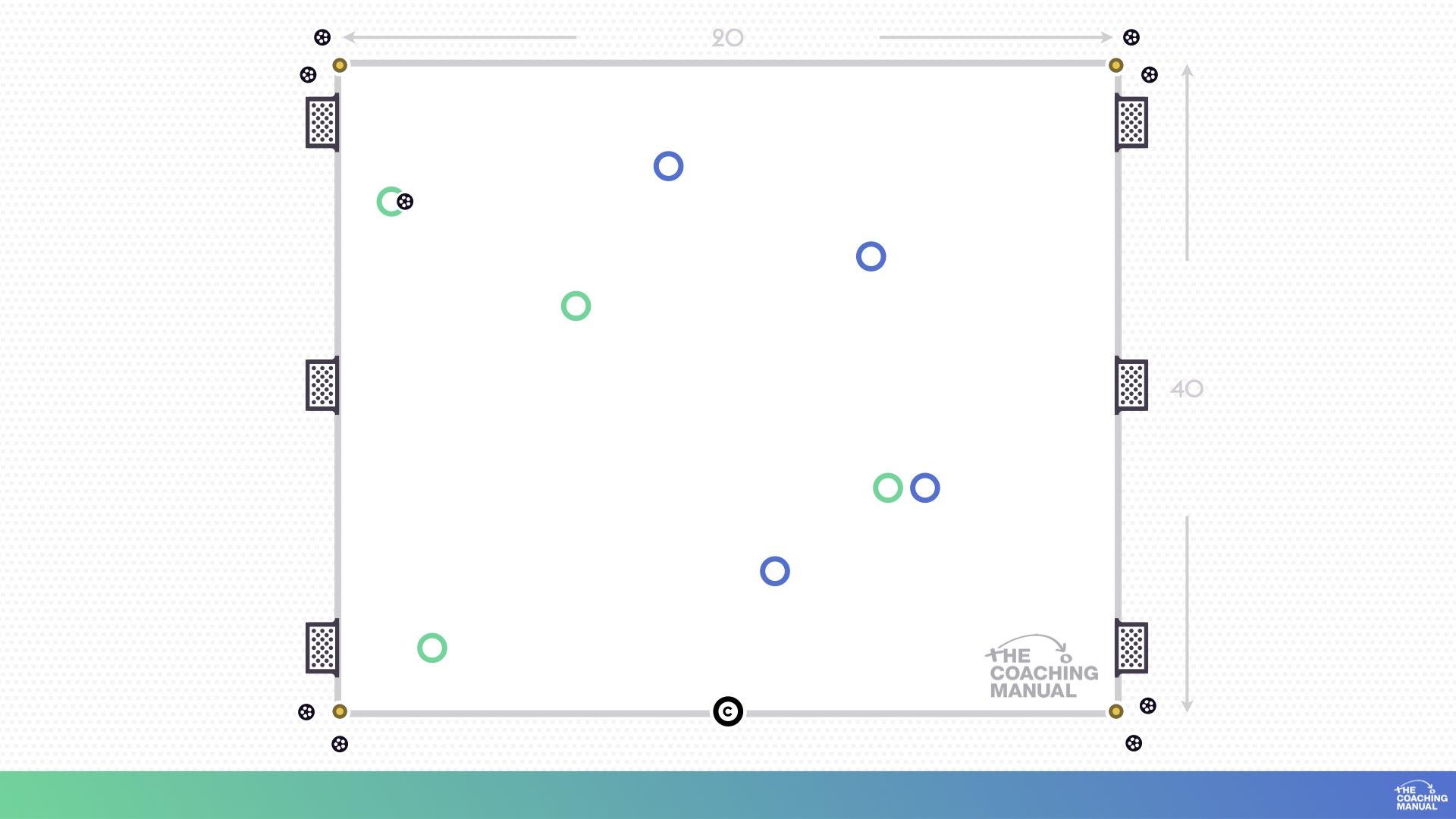
A 4v4 where each team attacks three goals. Children quickly learn that the open goal is away from the crowd.

  • 20 min
  • Area 40 x 20
  • 8 players
  • 6 mini-goals, bibs, spare balls

How it works

  1. Put three mini-goals at each end.
  2. Play 4v4. Each team attacks three goals and defends three.
  3. Normal rules otherwise.

Coaching points

  • Look for the free goal. If everyone is crowded around one goal, switch to another.
  • Ball mastery. Use both feet and different parts of the foot to move the ball away from pressure.
  • Take players on. Be brave in 1v1s. Try a sidestep.

Open the full drill with animation in TCMPremium

Common question

Why U8s bunch around the ball, and what actually fixes it

Every U8 team bunches. Seven-year-olds see the ball and go to it. It isn't bad coaching, and shouting “spread out!” or fixing children in positions won't change it. Changing the game will.

  1. Add goals. Four and six-goal games mean the open goal is always away from the crowd. Players learn to switch without being told.
  2. Shrink the teams. Play 2v2 and 3v3 in training. With fewer players there's less to bunch around.
  3. Widen the pitch. A wide pitch gives space to dribble into and makes the space easy to see.
  4. Overloads. A 5v2 or a floating player gives the team with the ball a spare player to find, so passing into space starts to make sense.
  5. Praise the space. When a player moves away from the crowd and gets the ball, make a big deal of it.
  6. Be patient. Most players start to spread out on their own from around U9 and U10, as they get better on the ball.

Questions coaches ask

What should I do with my under 8s in training tonight?

Start with a 3v3 game as players arrive, then a ball mastery warm-up, a passing practice and a six-goal game. That's the 60-minute session on this page.

How do I stop my U8 team bunching around the ball?

Change the game, not the instructions. Use four or six goals, smaller teams, wider pitches and overloads. Bunching is normal at this age and fades as players get better on the ball.

How long should an under 8s training session be?

About an hour, with drinks breaks and most of the time spent playing games.

What format do U8s play?

In England, 5v5 from the 2026/27 season. US Soccer recommends 4v4 with no goalkeepers.

Other ages

Drills for every age

Pick an age to see its drills and session plan, or read what to expect at each age.

A season plan for every age

The Coaching Manual has 2,000+ full sessions with video, and ready-made season plans for every age group. Start free as a coach, or give every coach at your club the same plan.