Home / Age groups / U14

Under 14s · football (soccer) drills

U14 football drills: playing out from the back

U14 is the first year of 11v11 in England, and the bigger pitch makes it the right time to teach playing out from the back. The session below builds it in three steps: an unopposed pattern, a practice with defenders, then a game. Every drill has a diagram and coaching points.

  • 75–90minute sessions
  • 11v11England and US
  • 6drills with diagrams

U14 at a glance

  • England match format11v11. From 2026/27, U14 is the first year of 11v11.
  • US match format11v11.
  • Session length75 to 90 min
  • Coaching focusThe 11v11 game. Big physical differences between players of the same age.
What to expect

What under 14s need

The FA’s four corners, with technical and tactical split. Tactics are now central to the work.

Technical

Technique at match speed, positional detail without losing all-round skill. Keep working the weaker foot.

Tactical

Team shape, units and roles. The move to 11v11 brings new ideas: lines, distances, switching play.

Physical

Peak growth for many boys. Growth-related aches in knees and heels are common. Early and late developers can look years apart, so don’t select on size.

Psychological

Self-conscious and testing independence. Drop-out risk rises. Give them a voice in how the team works.

Social

Teammates matter enormously. Respect, belonging and a reason to keep turning up keep players in the game.

How coaching changes from U5 to U18 →

Session plan · about 75 minutes

A 75-minute session on playing out from the back

Built from two sessions in our U13–U14 season plan, Width and Forward Runs and Playing Out From The Back, with drinks breaks between blocks. You need cones, bibs, balls, a full-size goal and two small goals. Open the playing out session in TCM.

Play: gamesPractice: one theme, lots of repetition

6 drills with diagrams

U14 drills

Every drill comes from our U13–U14 season plan on The Coaching Manual, where you’ll find the full session with an animation. Areas are in metres or yards: near enough is fine.

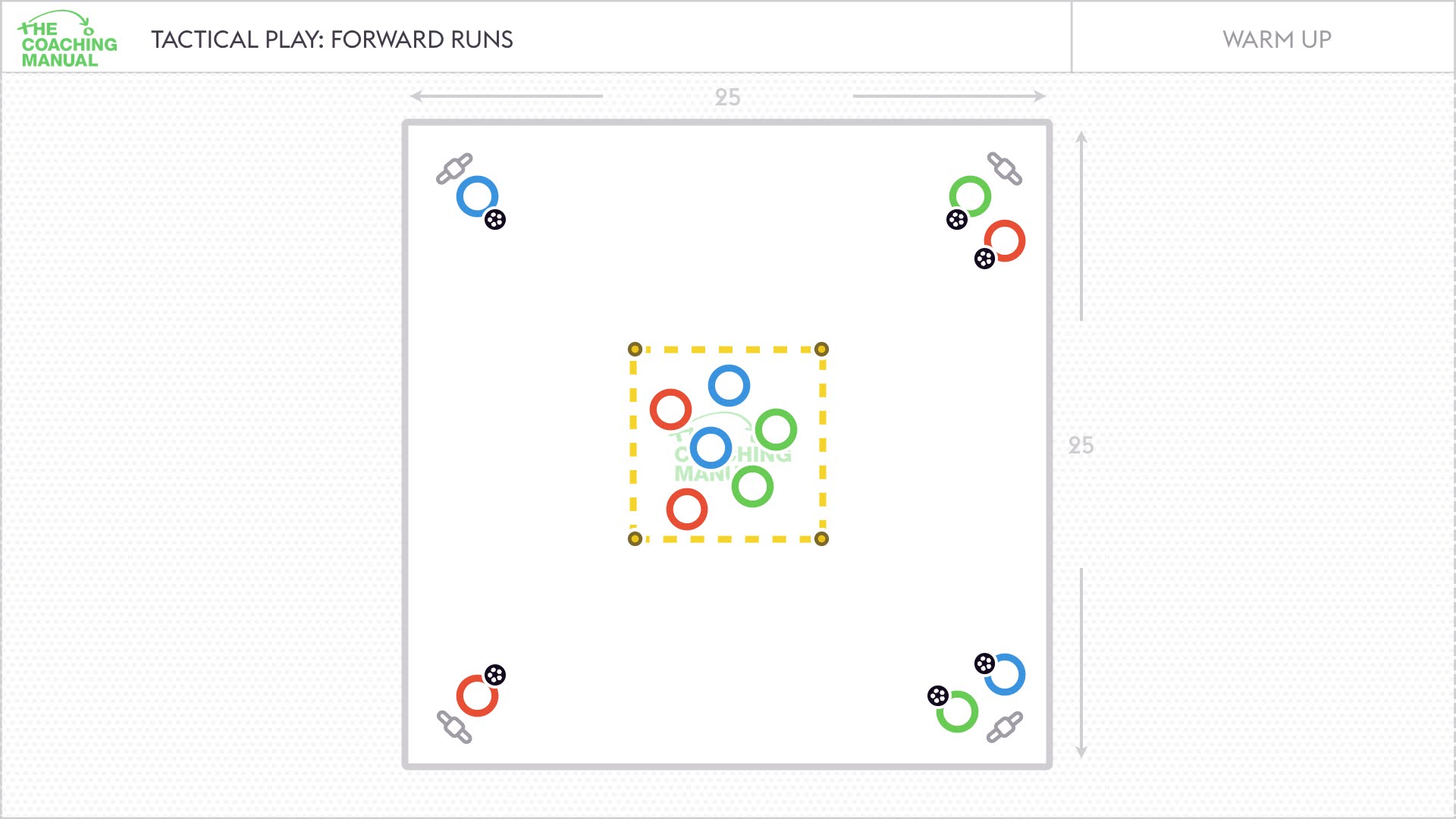
Diagram: Forward runs warm-up
Diagram from The Coaching Manual · By Anthony Limbrick
Drill 1 · In the session plan

Forward runs warm-up

Pass, move and run with the ball. A warm-up that gets players making runs and changing speed before the main work.

  • 15 min
  • Area 25 x 25 with a small square in the middle
  • 12 players
  • 10 balls, 8 bibs, 10 cones, 4 mannequins or poles

How it works

  1. Put a mannequin or pole in each corner and mark a small square in the middle.
  2. A player with the ball combines with a teammate moving out of the small square.
  3. The receiver dribbles to any mannequin, then combines with a teammate in the small square. The player who passed moves into the square.

Coaching points

  • Look around. Know where your teammates and the free mannequins are.
  • Time the run. Leave the square as the pass is ready, not before.
  • Change speed. Slow to receive, quick once you’re away.
Make it easier or harder

Make it easier

  • Only one ball per team.

Make it harder

  • Players can’t go to the same mannequin as a teammate.

Open the full session with animation in TCM

Diagram: Playing out from the back pattern
Diagram from The Coaching Manual · By Anthony Limbrick
Drill 2 · In the session plan

Playing out: unopposed pattern

The pattern without pressure first, so players learn the positions, angles and timing before defenders arrive.

  • 15 min
  • Area 25 x 25
  • 14 players
  • 6 balls, 14 bibs, 14 cones, mannequins

How it works

  1. Players stand next to mannequins in their positions.
  2. The goalkeeper plays to a centre-back, who plays to the full-back. The ball goes through midfield, with the full-back overlapping to receive and find the target player.
  3. Work it down the left, then the right. Players stay in position, or rotate with the player on the same mannequin.

Coaching points

  • Footwork. Adjust your feet to receive side-on.
  • Quality pass. Firm, to the correct foot.
  • Timing. Arrive as the ball does, not before.
  • Midfield rotation. Midfielders swap and drop to open up the pass.
Make it harder

Make it harder

  • Set players individual challenges.

Open the full session with animation in TCM

Diagram: Play out to the targets
Diagram from The Coaching Manual · By Anthony Limbrick
Drill 3 · In the session plan

Play out to the targets

Now with defenders. The team has to secure the ball, get into shape and play through to a target player.

  • 15 min
  • Area 60 x 35
  • 12 players
  • 5 balls, 12 bibs, 10 cones, full-size goal

How it works

  1. A full-size goal and goalkeeper at one end, and two boxes with a target player at the other.
  2. A target player plays a long ball into the keeper. The team protects the keeper until the ball is secure, then spreads into its starting positions.
  3. The keeper plays to a defender and the team tries to move the ball up to a target player while the defenders try to win it.

Coaching points

  • Safe possession. Keep the ball first, go forward when it’s on.
  • Team shape. Make the pitch big as soon as the keeper has it.
  • Body shape. Side-on, so you can see the press and the space.
  • Decide. Play through, round or over the press.

Open the full session with animation in TCM

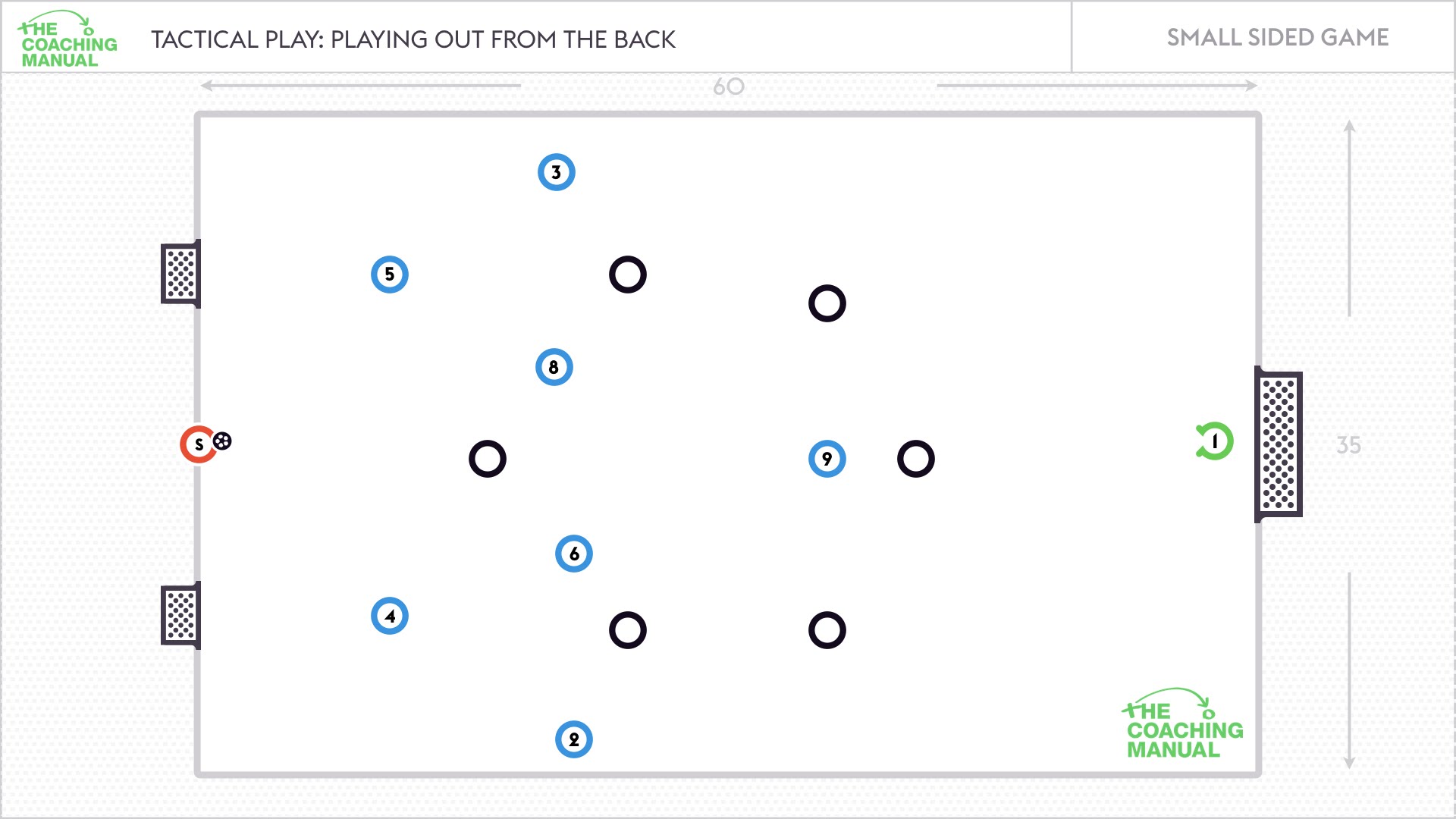
Diagram: Playing out from the back game
Diagram from The Coaching Manual · By Anthony Limbrick
Drill 4 · In the session plan

Playing out game

A game where one team has to build from the back against a team that presses and counter-attacks.

  • 20 min
  • Area 60 x 35
  • 15 players
  • 6 balls, 15 bibs, 10 cones, full-size goal, 2 small goals

How it works

  1. The team playing out lines up 4-2-1 in front of its goalkeeper and tries to build up the pitch to score.
  2. The other team sets up 3-1-2 with a goalkeeper. When they win the ball, they attack two small goals.

Coaching points

  • Look before you receive. Know where the press is coming from.
  • Body shape. Open up to play forward.
  • Receive and pass well. Speed and accuracy break the press.
  • Play forward. Look for the pass into the next line first.
Make it easier or harder

Make it easier

  • The keeper starts with the ball in their hands.

Make it harder

  • Set players individual challenges.

Open the full session with animation in TCM

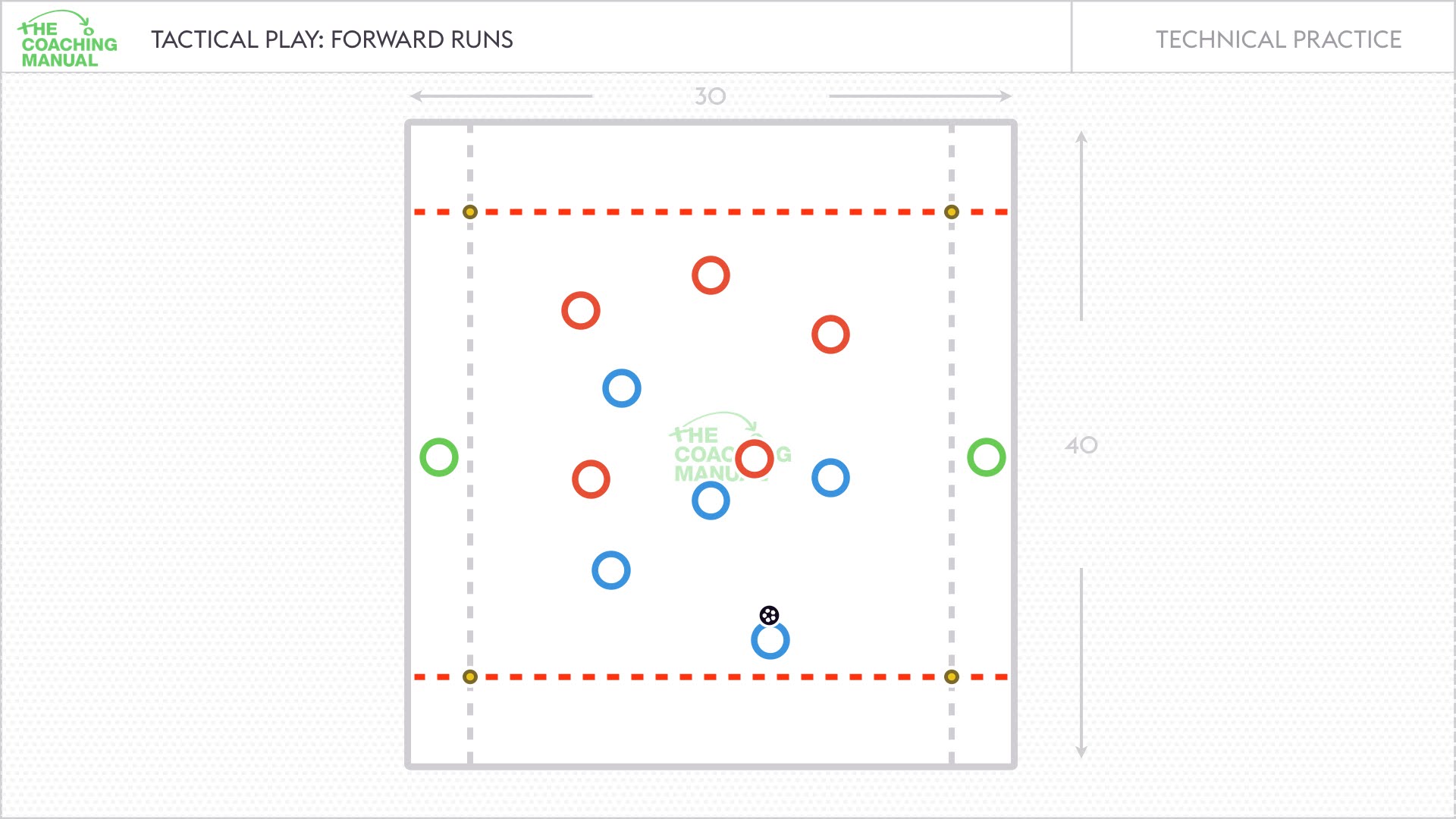
Diagram: Forward runs to an end zone
Diagram from The Coaching Manual · By Anthony Limbrick
Drill 5

Forward runs to an end zone

Score by arriving in the end zone, not waiting in it. A simple way to teach the timing of forward runs.

  • 20 min
  • Area 40 x 30, with wide channels and end zones
  • 13 players
  • 10 balls, 13 bibs, 20 cones

How it works

  1. Mark a channel down each side and an end zone at each end.
  2. Teams score by running the ball into the end zone or receiving a pass in it.
  3. Players can’t wait in the end zone, or they’re offside: they have to run onto the pass. Middle players can combine with the two wide players.

Coaching points

  • Timing of runs. Go when the passer can see you and play it.
  • Quality of pass. Into space, ahead of the runner.
  • Run with the ball. If there’s space ahead, take it.
Make it easier or harder

Make it easier

  • Add a floating player to make a bigger overload.

Make it harder

  • Allow one defender into a wide channel to press.

Open the full session with animation in TCM

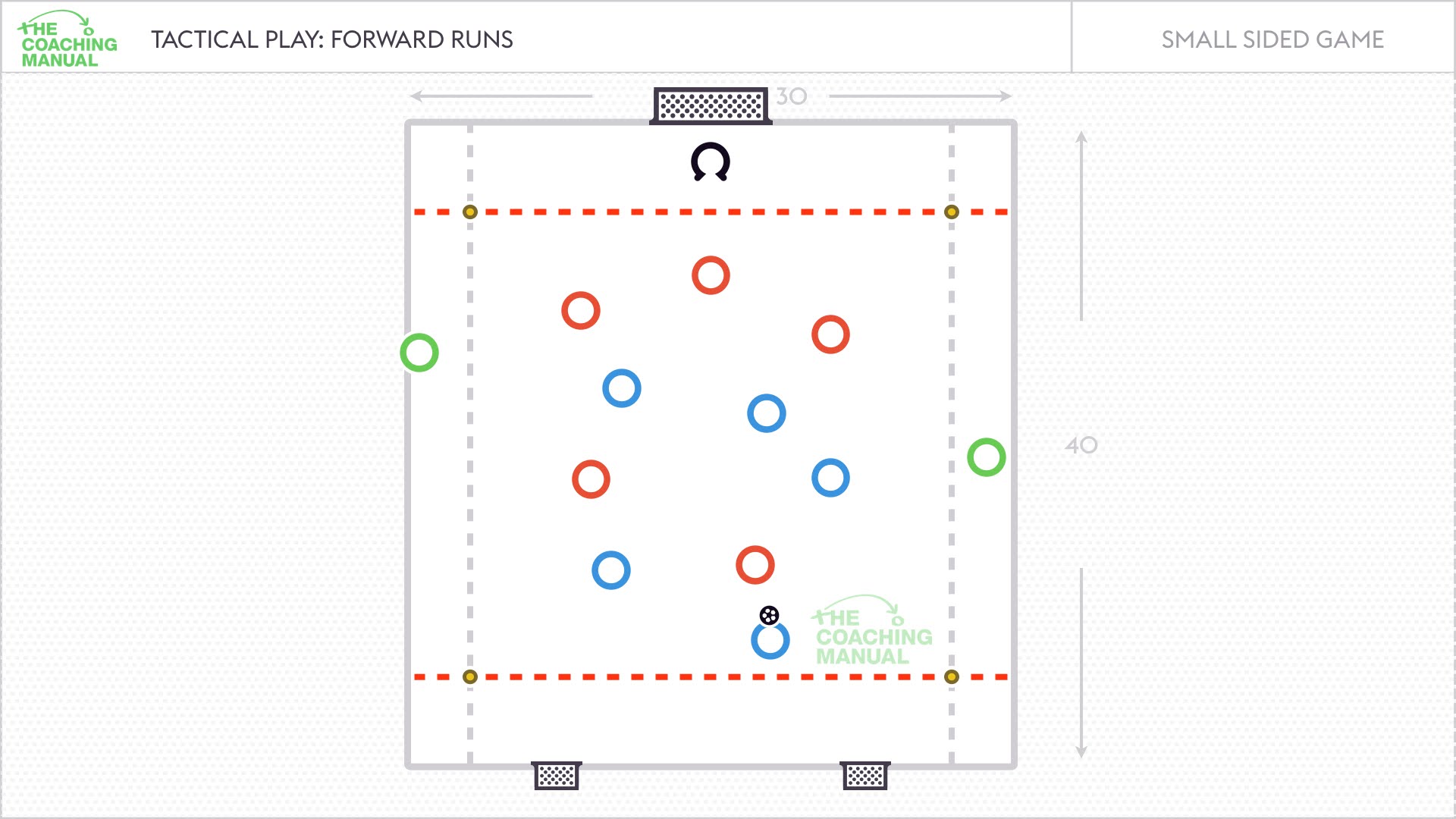
Diagram: 5v5 with wide players and offside lines
Diagram from The Coaching Manual · By Anthony Limbrick
Drill 6

5v5 with wide players and offside lines

A game that stretches the pitch, so forward runs and width make the difference.

  • 20 min
  • Area 40 x 30
  • 13 players
  • 10 balls, 12 bibs, 10 cones

How it works

  1. Play 5v5 in the middle, with one player for each team locked in a wide zone.
  2. Both teams have an offside line, which lets them stretch the play.

Coaching points

  • Read the play. Time your run off the passer, not the defender.
  • Use the width. Wide players stretch the defence and open up the middle.
  • Run with the ball. Drive into space when it opens.
Make it harder

Make it harder

  • Two touches maximum to speed up play.
  • After every pass, the passer must make a forward run.

Open the full session with animation in TCM

Common question

How do you coach playing out from the back?

Playing out isn’t about never kicking it long. It’s about giving the goalkeeper and defenders good options, so the team can keep the ball and move it up the pitch when the chance is there.

  1. The goalkeeper is the first attacker. They need to be comfortable receiving and passing with both feet.
  2. Make the pitch big. Centre-backs split wide, full-backs push high and wide. A big pitch is much harder to press.
  3. Body shape. Receive side-on so you can see forward and play on quickly.
  4. Midfield movement. Midfielders drop, rotate and find angles so there is always a pass into the next line.
  5. Know when to go long. Playing out is a choice, not a rule. If the press has everything covered, go over it.
  6. Expect mistakes. They will lose the ball sometimes. Learning comes from trying it in matches, not just in training.

Questions coaches ask

How do I coach playing out from the back?

Start with an unopposed pattern from the goalkeeper through the defenders and midfield, then add defenders, then play a game where one team has to build from the back. Coach a goalkeeper who is comfortable on the ball, a big pitch with defenders split wide, side-on body shape and midfielders moving to give angles. The session on this page follows those steps.

What format do U14s play?

11v11 in both England and the US. In England, U14 is now the first year of 11v11.

How long should a U14 training session be?

75 to 90 minutes, with most of the time in game-like practices.

What changes when a team moves to 11v11?

A bigger pitch and more players bring new ideas: team shape, lines and distances between players, switching play, and building from the back. Players also cover more ground, so recovery matters more.

Other ages

Drills for every age

Pick an age to see its drills and session plan, or read what to expect at each age.

A season plan for every age

The Coaching Manual has 2,000+ full sessions with video, and ready-made season plans for every age group. Start free as a coach, or give every coach at your club the same plan.