Home / Age groups / U16

Under 16s · football (soccer) drills

U16 football drills: defend as a unit, then counter

Good teams defend together and break quickly when they win it back. The session below works on both: staying compact and making play predictable, then counter-attacking at speed with overloads. Every drill has a diagram and coaching points.

  • 90minute sessions
  • 11v11England and US
  • 6drills with diagrams

U16 at a glance

  • England match format11v11.
  • US match format11v11.
  • Session length90 min
  • Coaching focusPosition-specific work and structured strength and conditioning.
What to expect

What under 16s need

The FA’s four corners, with technical and tactical split. Players can now lead more of the problem solving themselves.

Technical

Position-specific detail and technique when tired. Players should own their own technical targets.

Tactical

Game plans, reading opponents and changing things during a match. Players increasingly lead the problem solving.

Physical

Strength and conditioning now earns its place, built on good movement. Recovery and load start to matter.

Psychological

Competition and results matter more to players. Resilience, handling mistakes and exam pressure all show up on the pitch.

Social

School, work and social life compete for time. Keeping the game enjoyable keeps them playing.

How coaching changes from U5 to U18 →

Session plan · about 90 minutes

A 90-minute defend-and-counter session

Built from two sessions in our U15–U16 season plan, Defending as a Unit in Balance and Counter Attacking. Allow 15 minutes for a physical warm-up and drinks breaks. You need cones, bibs, plenty of balls, mannequins, two full-size goals and small goals. Open the defending session in TCM.

Play: gamesPractice: one theme, lots of repetition

6 drills with diagrams

U16 drills

Every drill comes from our U15–U16 season plan on The Coaching Manual, where you’ll find the full session with an animation. Areas are in metres or yards: near enough is fine.

Diagram: Switch-pass warm-up
Diagram from The Coaching Manual · By Terry Moore
Drill 1 · In the session plan

Switch-pass warm-up

A team passing competition with long switches between areas, to prepare for the long passes that start a counter.

  • 10 min
  • Two areas of 20 x 10
  • 10 players
  • 2 balls, 10 bibs, 24 cones

How it works

  1. Split players into two teams, one in each area.
  2. Each team passes and moves within its area.
  3. On the coach’s call, a player plays the ball across into the other area.

Coaching points

  • Pass and receive. Crisp passes, receive on the move.
  • Switch the play. Strike the long pass cleanly and accurately.
  • Receive in the air. Cushion the ball down with your first touch.
Open the full session with animation in TCM

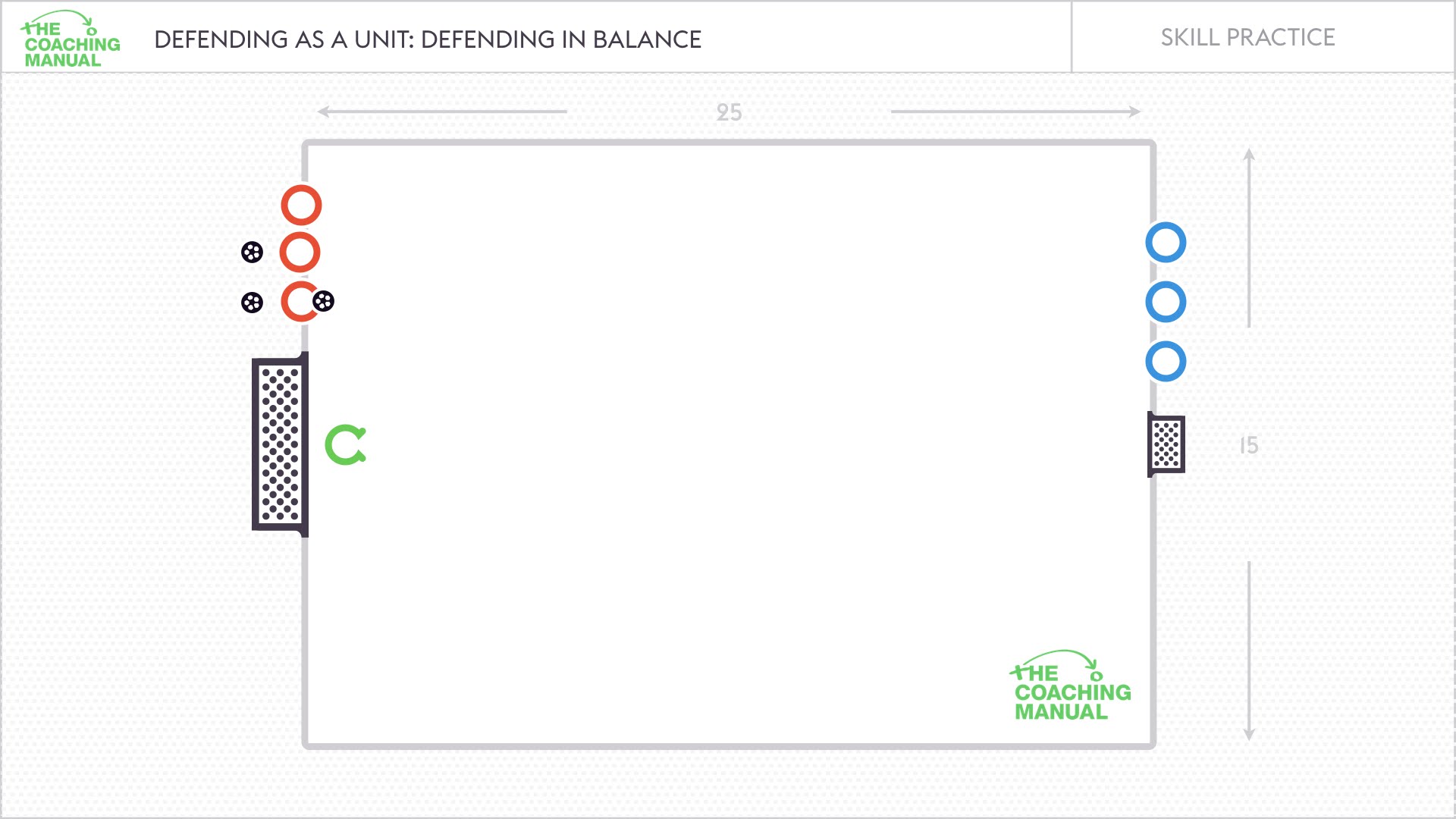
Diagram: Defending in balance
Diagram from The Coaching Manual · By Alex Ball
Drill 2 · In the session plan

Defending in balance

Defenders choose how many attackers to face: the fewer they take on, the more points a clean sheet is worth.

  • 15 min
  • Area 25 x 15 (one or two pitches)
  • 14 players
  • 6 balls, 6 bibs, 20 cones, a large goal and a small target goal

How it works

  1. Defenders start in line with the large goal, attackers on the small goal line.
  2. The defenders choose to face one, two or three attackers. Not conceding 1v1 scores 3 points, 2v2 scores 2, 3v3 scores 1.
  3. If the defenders win the ball, they can counter into the small target goal for a bonus point. Rotate teams and keep score.

Coaching points

  • Press. The nearest defender closes down the ball.
  • Show them away from goal. Make play predictable.
  • Support. The next defender covers the presser.

Open the full session with animation in TCM

Diagram: Counter-attack 3v2
Diagram from The Coaching Manual · By Terry Moore
Drill 3 · In the session plan

Counter-attack 3v2

Attack quickly before the defence can recover, with the coach deciding which defender gets back.

  • 15 min
  • Area 40 x 60
  • 12 players
  • 5 balls, 6 bibs, 10 cones, a full-size goal and 2 small goals

How it works

  1. Attackers pass between themselves, then play forward to the players on the pitch and join the attack.
  2. The coach calls a number from 1 to 4, and that defender joins the defender already on the pitch to make it 3v2.
  3. Attackers try to score. If the defenders win the ball, they score in either of two small goals. Rotate positions and numbers.

Coaching points

  • Look up. See the space before the defender gets back.
  • Speed of play. Move the ball forward quickly.
  • Get the shot away. Don’t give defenders time to recover.
Make it easier or harder

Make it easier

  • Add more attackers.

Make it harder

  • Two defenders join in to make it 3v3.
  • Three attackers break and the coach calls two numbers to make it 4v3.

Open the full session with animation in TCM

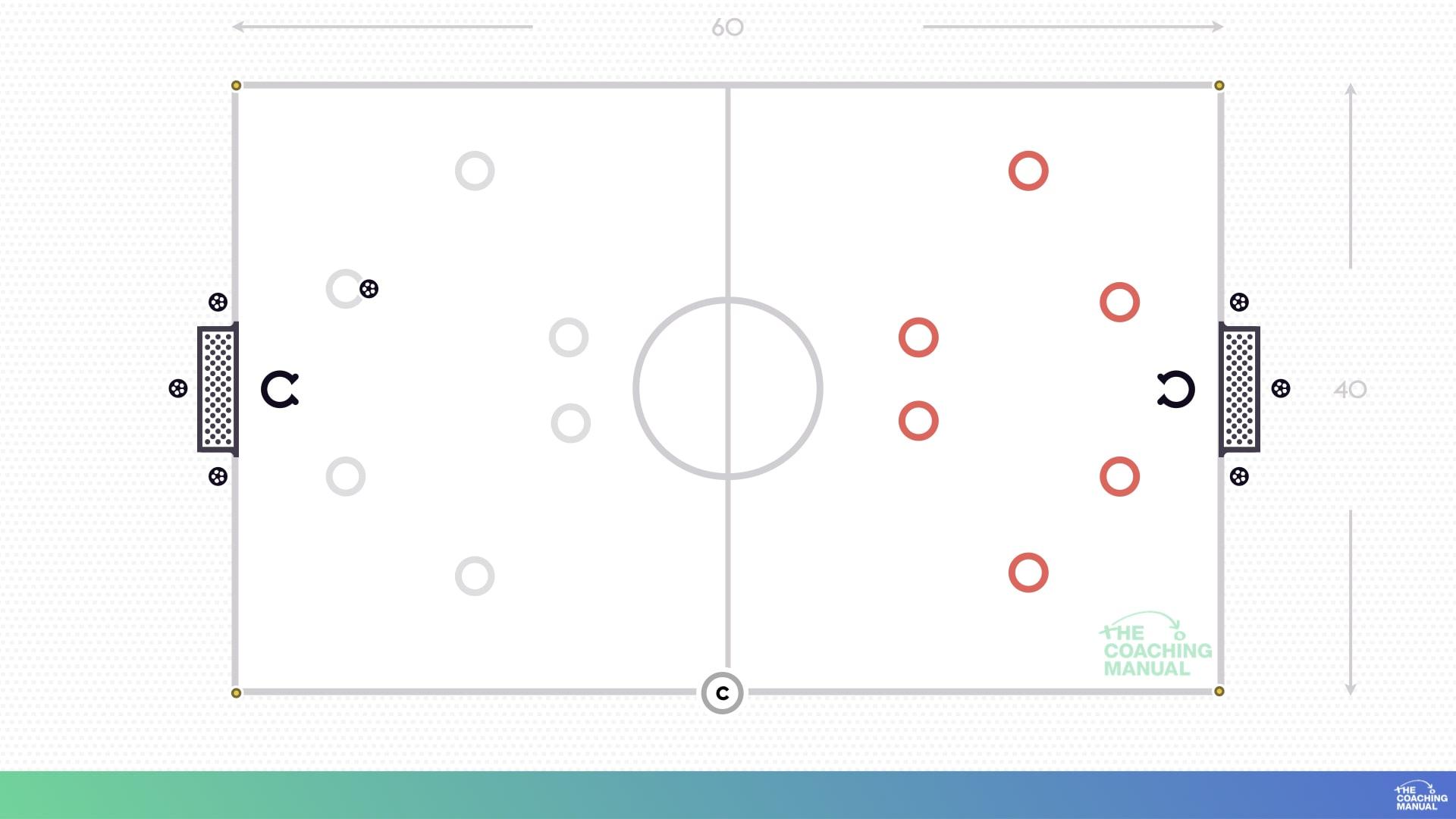
Diagram: Counter-attacking overloads game
Diagram from The Coaching Manual · By Terry Moore
Drill 4 · In the session plan

Counter overloads game

Every turnover becomes a 3v2 break at the other end, so players practise attacking and recovering at speed.

  • 20 min
  • Area 40 x 60, with a central square
  • 12 players
  • 5 balls, 12 bibs, 8 cones, 2 goals

How it works

  1. The goalkeeper starts with the ball and passes to a defender, who plays into the attacker.
  2. Two teammates break from the central square to make a 3v2 in the attacking half.
  3. If possession is lost, those two players go back to the central square and two from the other team break to make a 3v2 the other way.

Coaching points

  • Decide quickly. Pass, run with it or shoot?
  • Use the overload. Commit a defender, then release the free player.
  • Speed of attack. Score before the defence is set.
Make it easier or harder

Make it easier

  • Add more attackers.

Make it harder

  • Set players individual challenges.

Open the full session with animation in TCM

Diagram: Hold the lead scenario game
Diagram from The Coaching Manual · By Alex Ball
Drill 5 · In the session plan

Hold the lead

A scenario game: you’ve just scored and there are five minutes left. Can you stay compact and see it out?

  • 15 min
  • Area 60 x 40
  • 14 players
  • 6 balls, 20 bibs, 20 cones, 2 goals

How it works

  1. Teams take turns. One team is told it has just scored and there are five minutes left.
  2. Its job is not to concede an equaliser. The other team presses to win the ball back high up the pitch.
  3. Swap roles and compare.

Coaching points

  • Compactness. Keep the distances short between players and lines.
  • Cover and balance. Protect the space behind the presser.
  • Recover and delay. Slow the attack down when outnumbered.
  • Control and restraint. Stay on your feet in and around the box.

Open the full session with animation in TCM

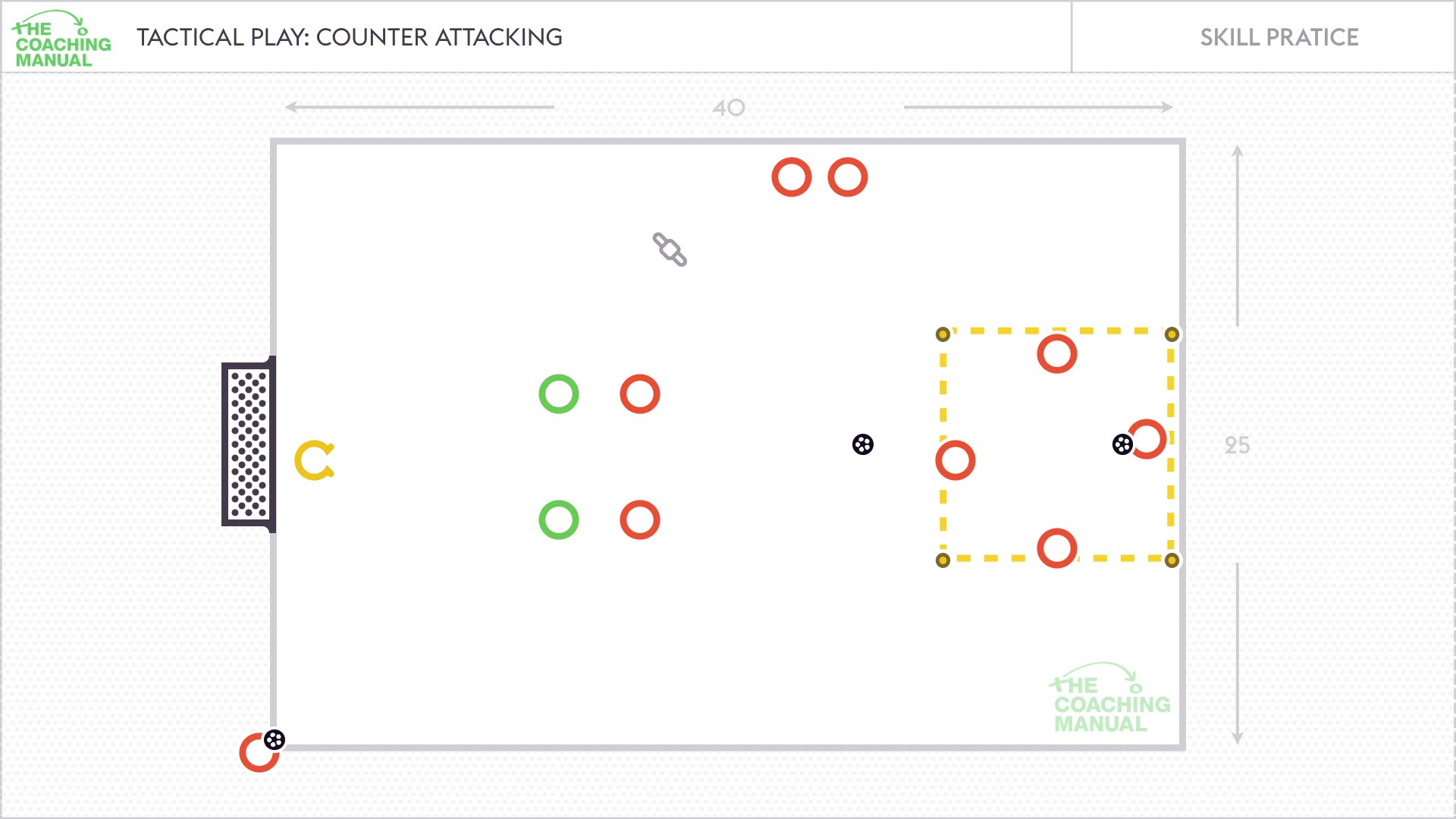
Diagram: Three-ball counter into the box
Diagram from The Coaching Manual · By Terry Moore
Drill 6

Three-ball counter into the box

Three balls in quick succession: a central break, a wide delivery and a cross, so attackers keep arriving in the box.

  • 15 min
  • Area 40 x 25
  • 12 players
  • 18 balls, 10 bibs, 10 cones, mannequins, a goal

How it works

  1. Ball 1: a player from the feeding square passes to an attacker and joins in for a 3v2 to finish.
  2. Ball 2: when that attack ends, the next ball goes to a wide player, who beats the mannequin and delivers for a 4v2.
  3. Ball 3: a cross comes in straight away for another 4v2 finish.

Coaching points

  • Decide quickly. Shoot, pass or carry?
  • Speed of attack. Reset fast for the next ball.
  • Quality of delivery. Into the space attackers are running into.
  • Movement into the box. Attack different areas: near post, far post, edge of the box.
Make it easier

Make it easier

  • Add more attackers.

Open the full session with animation in TCM

Common question

How do you coach a team to defend as a unit?

Defending as a unit means every player’s position depends on the ball and on each other. When it works, the opposition runs out of space and the team wins the ball in good positions to counter.

  1. Stay compact. Short distances between players and between the lines, so there are no gaps to play through.
  2. Press, cover and balance. One player presses the ball. The next covers behind them, and the rest balance across the pitch.
  3. Slide together. Move across as a unit when the ball moves, not one player at a time.
  4. Show them away from goal. Make play predictable by forcing it wide or backwards.
  5. Delay and recover. When outnumbered, slow the attack down until teammates get back.
  6. Control and restraint. Stay on your feet and pick the moment to tackle.

Questions coaches ask

How do I coach a team to defend as a unit?

Teach the team to stay compact, with short distances between players and lines. One player presses the ball while teammates cover and balance behind them, and the whole unit slides together. Show attackers away from goal, delay when outnumbered, and stay on your feet.

How do I coach counter-attacking?

Practise breaking quickly as soon as the ball is won: the first pass forward, runners breaking in support, and getting a shot away before defenders recover. Overloads such as 3v2 help players learn to attack at speed.

What format do U16s play?

11v11 in both England and the US.

How long should a U16 training session be?

About 90 minutes, including a warm-up, with most of the time in game-like practices.

Other ages

Drills for every age

Pick an age to see its drills and session plan, or read what to expect at each age.

A season plan for every age

The Coaching Manual has 2,000+ full sessions with video, and ready-made season plans for every age group. Start free as a coach, or give every coach at your club the same plan.